How to Track Calories When You Eat Out (Without Guessing)
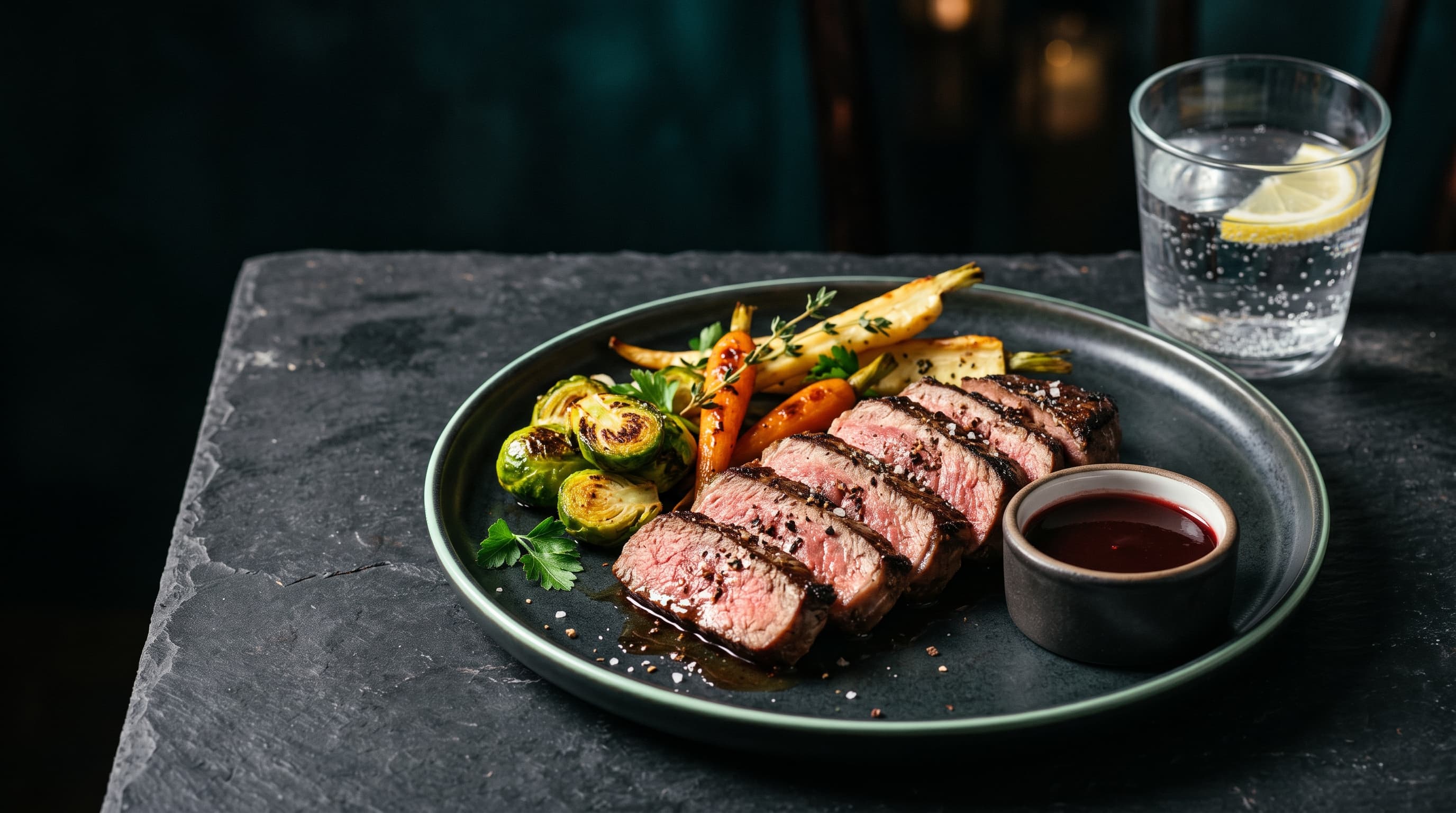
TL;DR: Chain menu calories are accurate on average but unreliable item by item, and independent restaurants average around 1,200 calories a meal with no label at all. Diners typically underestimate a restaurant meal by 175 to 260 calories, and the miss gets bigger at places that market themselves as healthy. The fix is not better guessing. Log the closest chain equivalent, add roughly 20 percent, make your real decisions at ordering time (oil, sides, drinks), and hold yourself to a weekly calorie average rather than a perfect daily log.
Most people don't blow a cut with a bad training program. They blow it on four restaurant meals a month that get logged at half their real size. Everything else is dialed, the scale won't move, and the honest explanation is sitting in a log entry that says "grilled chicken salad, 420 calories" for a plate that was closer to 900.
This is a solvable problem, but not by trying harder to guess. Here's what the data actually says, and what to do with it.
Chain menu numbers are better than the internet thinks
The standard cynical take is that restaurants lie about calories. That's mostly not true, at least for large chains. Researchers at Tufts bought 269 food items from national fast food and sit-down chains in three cities and measured them in a lab. Averaged across everything, the measured calories came in about 10 calories above what the menu claimed (Urban et al., 2011). At the population level, that's close enough to call accurate.
The problem is the spread. Nineteen percent of items contained at least 100 calories more than listed, and one item came back a full 1,000 calories over. The errors also weren't random. They clustered on the lower-calorie items, the exact ones a person watching their weight would order. A 350-calorie entree that's really 500 is a 43 percent miss. A 900-calorie burger that's really 950 barely matters.
So the practical read on chain menus: trust the number as a starting point, distrust it most when it looks impressively low.
The bigger problem is restaurants that don't post anything
Chains are the easy case. The harder case is your local Italian place, which posts nothing and portions by feel.
The same Tufts group later bought 364 meals from independent and small-chain restaurants across San Francisco, Boston and Little Rock. Meals averaged 1,205 calories, and the three most popular cuisines in the sample (American, Italian and Chinese) averaged 1,495 calories per meal (Urban et al., 2016). That's before drinks, before an appetizer, before bread. One meal at a normal neighborhood restaurant can be most of a day's intake for someone in a deficit.
If you have no label, the honest default assumption for a full restaurant entree is not 600 calories. It's somewhere north of 1,000.
Your estimate is off, and predictably so
The instinct is to just eyeball it. That fails in a consistent direction.
When researchers surveyed thousands of diners leaving fast food restaurants and compared their estimates to the actual meals, people underestimated by an average of 175 to 260 calories depending on the group (Block et al., 2013). Note that's fast food, where portions are standardized and the numbers are printed on the wall. Estimation at an independent restaurant is worse.
It also gets worse when the restaurant feels healthy. That's the "health halo" effect: given equivalent meals, people estimate substantially fewer calories when the food comes from a brand positioned as healthy (Chandon and Wansink, 2007). Salad bowls, poke, grain bowls, and anything with the word "fresh" on the sign all trigger it. The dressing, the sauce, the tahini drizzle, and the two ounces of oil the kitchen cooked it in are invisible and they're most of the gap.
And this isn't a small-effect curiosity. In the classic New England Journal study of people who insisted they couldn't lose weight on 1,200 calories, actual intake was underreported by roughly 47 percent (Lichtman et al., 1992). The mechanism wasn't lying. It was untracked meals and underestimated portions, which is exactly what a restaurant meal is.
The system: four rules
1. Log the closest chain equivalent, not the actual restaurant. No label for your local pad thai? Find the nutrition page for a national chain that sells pad thai and use that entry. You're not looking for precision, you're looking for a number built from a real recipe rather than from optimism.
2. Add 20 percent. This is the single highest-value habit in this article. Restaurant kitchens cook with more fat than you do, because fat is how food tastes good at scale. A 20 percent uplift on whatever you logged absorbs the oil in the pan, the butter finish, the larger-than-standard portion, and the two bites of someone else's dessert. If the meal felt rich, make it 30 percent.
3. Decide at the order, not at the log. Your leverage is almost entirely in three choices, made before the food arrives: cooking fat (ask for grilled instead of pan-fried, sauce on the side), starch sides (fries and bread are where 400 easy calories hide), and liquid calories. Once the plate is in front of you, the meal's calories are already fixed and all you're doing is bookkeeping. This also means you can eat out and stay on plan without ordering sadly. A steak, a vegetable, and a glass of wine logs cleanly. A pasta dish with bread and two cocktails does not.
4. Judge the week, not the meal. Your body responds to the weekly average, not to Saturday. If you're eating at a 500 calorie daily deficit and one restaurant meal runs 800 over, that's a week at a 386 calorie deficit instead of 500. Still a cut. Still progress. The failure mode isn't the meal, it's deciding the day is ruined and eating another 1,500 calories on top. If you eat out often, plan the week around it deliberately, the same way you would bank calories around a weekend of drinking.
What this looks like in practice
You don't need lab-grade accuracy. You need your error to be small and consistent, because a consistent bias is something you can correct against. If your logged intake is reliably 10 percent light and your weight isn't moving, you adjust your target down and keep going. If your error swings between 5 percent and 60 percent depending on where you ate, no amount of adjusting will land.
That's why the flat 20 percent uplift beats trying to be clever. It converts a wild, direction-unknown error into a small, known one.
Two things worth reading alongside this: how to count calories without a food scale covers hand and reference-object portioning, which is the same skill applied to a plate you didn't build. And if you want the number your weekly average should be aimed at in the first place, start with how to calculate your maintenance calories and then set targets with the macro calculator.
One more note on photo-based logging, since it's the obvious shortcut here. AI meal scanning is genuinely useful for restaurant food because it estimates from what's actually on the plate rather than from a menu description. It's also not magic, and the accuracy limits are worth understanding before you lean on it: I broke those down in how accurate AI food scanners really are.
That's the honest case for how we built meal logging in Protokl. Point the camera at the plate, get a macro estimate in a couple of seconds, adjust it if it looks light, and move on. It doesn't turn a 1,400 calorie plate of pasta into a good idea. It just means the meal you can't weigh still ends up in the log instead of getting skipped, which is the actual reason most people's numbers stop matching the scale.
Eat out. Log it heavy. Watch the week.
Post to Instagram / TikTok
Tap Share, choose Instagram or TikTok, and this 1080×1080 card loads straight into the post composer — ready to publish. Add your caption and point your bio link back here, since links aren’t tappable inside IG/TikTok posts.
Related reading
- How to Manage Hunger on a Cut Without Eating More CaloriesHunger is the reason most cuts fail, and it's more controllable than people think. Here's what actually moves appetite at a fixed calorie target: protein dose, food volume, processing level, and sleep.
- How to Break a Weight Loss PlateauStuck at the same weight for weeks? Most plateaus aren't metabolic. Here's how to diagnose the real cause in order, and what to do when adaptation is genuine.
- Should You Weigh Food Raw or Cooked? (The Error Costs You 90 Calories a Meal)Cooking changes a food's weight but not its calories. Here is the raw vs cooked rule, the yield numbers for chicken, beef, rice and pasta, and how to batch-cook without wrecking your log.
Want this as a daily protocol?
Protokl builds personalized workout and nutrition plans around your body composition, goals, and experience level. Science-backed. AI-powered. Syncs with Apple Health.
Get Protokl →