How to Manage Hunger on a Cut Without Eating More Calories
TL;DR: Most cuts don't fail because the math was wrong. They fail because the person got hungry enough to stop. The useful insight is that hunger is only loosely tied to calorie count: two 1,800-calorie days can feel completely different depending on what's in them. Four levers do almost all of the work, and none of them cost you a single calorie.
Nobody quits a cut because they forgot how to subtract. They quit at 9pm on a Thursday, three weeks in, standing in front of the fridge, having done the math perfectly all day.
Hunger is the failure mode. And the thing almost nobody tells you is that hunger at a fixed calorie target is largely a design problem. You have real control over it, and it doesn't involve eating more.
Protein is the single biggest lever
The cleanest demonstration of this is still a study from twenty years ago that nobody has managed to improve on. Weigle and colleagues fed subjects a diet at maintenance calories, then raised protein from 15% to 30% of intake while keeping calories identical. Ratings of fullness went up immediately. Then they let the subjects eat freely at 30% protein, and intake dropped by about 441 calories per day without anyone being told to restrict. Over 12 weeks they lost weight and body fat while reporting they weren't trying (Weigle et al., 2005).
Read that again. A spontaneous 441-calorie deficit, created by changing the macro split and nothing else.
The mechanism is boring and well documented: protein blunts ghrelin, raises GLP-1 and peptide YY, and costs more energy to digest than carbs or fat. Leidy's review of the evidence puts the effective range around 1.2 to 1.6 g/kg of bodyweight per day for appetite control, with a meaningful benefit from spreading it across meals rather than backloading it into dinner (Leidy et al., 2015).
For a cut, that's the floor, not the target. You want more like 1.6 to 2.2 g/kg to protect lean mass anyway, and the satiety effect comes along free. Our full breakdown of the dosing is in how much protein you actually need per day, and the protein calculator will give you a number for your bodyweight in about ten seconds.
If you change one thing today, change this one.
Make the food take up space
Your gut reports volume and weight to your brain before it reports calories. That's why 500 calories of olive oil and 500 calories of vegetables and lean meat land completely differently.
Ello-Martin and colleagues ran this over a full year. Two groups, both told to cut fat. One group was additionally told to eat more water-rich foods, mainly fruit and vegetables. The added-volume group ate 25% more food by weight, lost more weight (7.9 kg vs 6.4 kg at one year), and reported less hunger (Ello-Martin et al., 2007). More food, less hunger, better result.
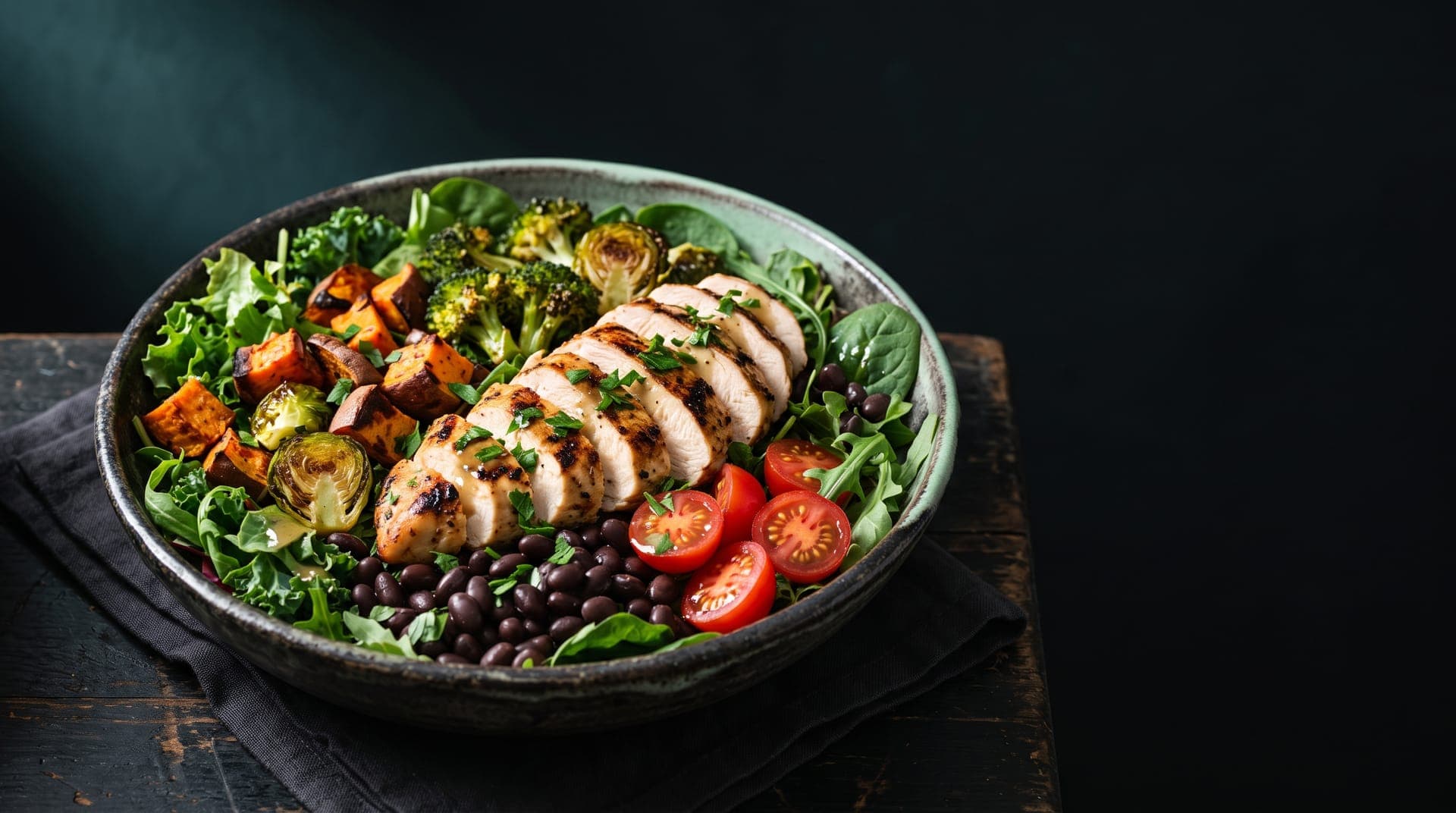
In practice this means building the plate around the bulky stuff first and fitting the dense stuff in afterward. A chicken breast on a bed of roasted vegetables and greens is a different experience from the same chicken breast with a half cup of rice, and it's the same calories. Soup, salad, and anything you have to chew for a while all buy you fullness at a discount.
Fiber does its own separate work here. The reviews are less dramatic than the protein literature but consistent: viscous soluble fibers slow gastric emptying and improve post-meal satiety, with the effect showing up most reliably at intakes above roughly 25 to 30 g per day (Clark and Slavin, 2013). That's a target most people miss badly while cutting, because fiber lives in exactly the foods people drop first.
And drink your calories at your own risk. Liquid calories are poorly compensated for, meaning a 300-calorie smoothie doesn't reduce your later intake the way 300 calories of solid food would (Mattes, 2006). On a cut, that's 300 calories you spent and didn't get fullness for.
Cut the foods engineered to be eaten fast
Hall's ward study is the most uncomfortable result in modern nutrition research. Twenty adults, locked in a metabolic ward, given either ultra-processed or unprocessed meals matched for calories, protein, carbs, fat, sugar, sodium, and fiber. Both groups were told to eat as much or as little as they wanted.
On the ultra-processed diet they ate about 500 calories more per day and gained weight. On the unprocessed diet they lost it. Same nutrients on paper. The processed meals were simply eaten faster, with a higher rate of calories per minute (Hall et al., 2019).
You don't need to be a purist about this. But when you're cutting, every food that lets you consume 400 calories in ninety seconds without noticing is working directly against you. The ones that require chewing, cutting, and time are working for you. Protein bars, flavored yogurts, and crackers are where cuts quietly leak.
Sleep is an appetite drug and you're probably underdosing it
Spiegel's work restricted healthy young men to four hours in bed for two nights. Leptin dropped 18%, ghrelin rose 28%, and self-reported hunger climbed about 24%, with the sharpest increase in appetite for calorie-dense, high-carb foods (Spiegel et al., 2004). Two nights. Nothing else changed.
If you're cutting on six hours of sleep and wondering why your willpower feels broken, it isn't willpower. You've raised the hormonal signal for hunger and then asked yourself to override it consciously, all day, every day. That's a losing setup. The full picture of what sleep does to body composition is in our guide to sleep, fat loss, and muscle gain, and it's the highest-leverage unpaid thing on this list.
If all four are dialed in and you're still starving, the deficit is wrong
At some point hunger stops being a design problem and starts being an accurate signal. There's a real ceiling on how much fat your body can release per day, set mostly by how much you're carrying, and pushing past it means the missing energy comes out of muscle and out of your sanity. We covered where that line sits in how big a calorie deficit is too big, and the cut calculator will size your deficit against your own body fat rather than a generic 500-calorie rule.
The other honest answer is that you might need to stop for a couple of weeks. A planned return to maintenance restores some of the hormonal drift and gives adherence a chance to reset, which is exactly what our guide to structuring a diet break walks through. A cut you pause and finish beats a cut you abandon in week five.
The short version
At a fixed calorie target, four things change how a cut feels: protein around 30% of intake, low energy density so the food has physical bulk, minimal ultra-processed food, and seven-plus hours of sleep. Get those right and the same deficit becomes something you can actually hold for twelve weeks.
None of that works if you can't see what you're eating, though. Protokl tracks your protein and fiber against your targets automatically, logs meals from a photo or a barcode so the tracking itself doesn't become the chore that ends the cut, and adjusts your calorie target off your actual weight trend instead of a formula that stopped being true in week three. If hunger has ended your last two cuts, start by fixing the four levers above, then let the app keep you honest about them.
Post to Instagram / TikTok
Tap Share, choose Instagram or TikTok, and this 1080×1080 card loads straight into the post composer — ready to publish. Add your caption and point your bio link back here, since links aren’t tappable inside IG/TikTok posts.
Related reading
- How to Train in a Calorie Deficit (Without Losing What You Built)The program isn't what decides whether you keep muscle on a cut. The size of the deficit is. Here's what the training research actually supports: deficit ceiling, volume floor, protein target, and realistic performance expectations.
- How to Break a Weight Loss PlateauStuck at the same weight for weeks? Most plateaus aren't metabolic. Here's how to diagnose the real cause in order, and what to do when adaptation is genuine.
- How Much Weight Can You Lose in a Month? (Realistic Numbers)The honest answer to how much weight you can lose in a month: what's water, what's fat, what the research says about safe rates, and how to set a monthly target you'll actually hit without burning muscle.
Want this as a daily protocol?
Protokl builds personalized workout and nutrition plans around your body composition, goals, and experience level. Science-backed. AI-powered. Syncs with Apple Health.
Get Protokl →