Should You Weigh Food Raw or Cooked? (The Error Costs You 90 Calories a Meal)
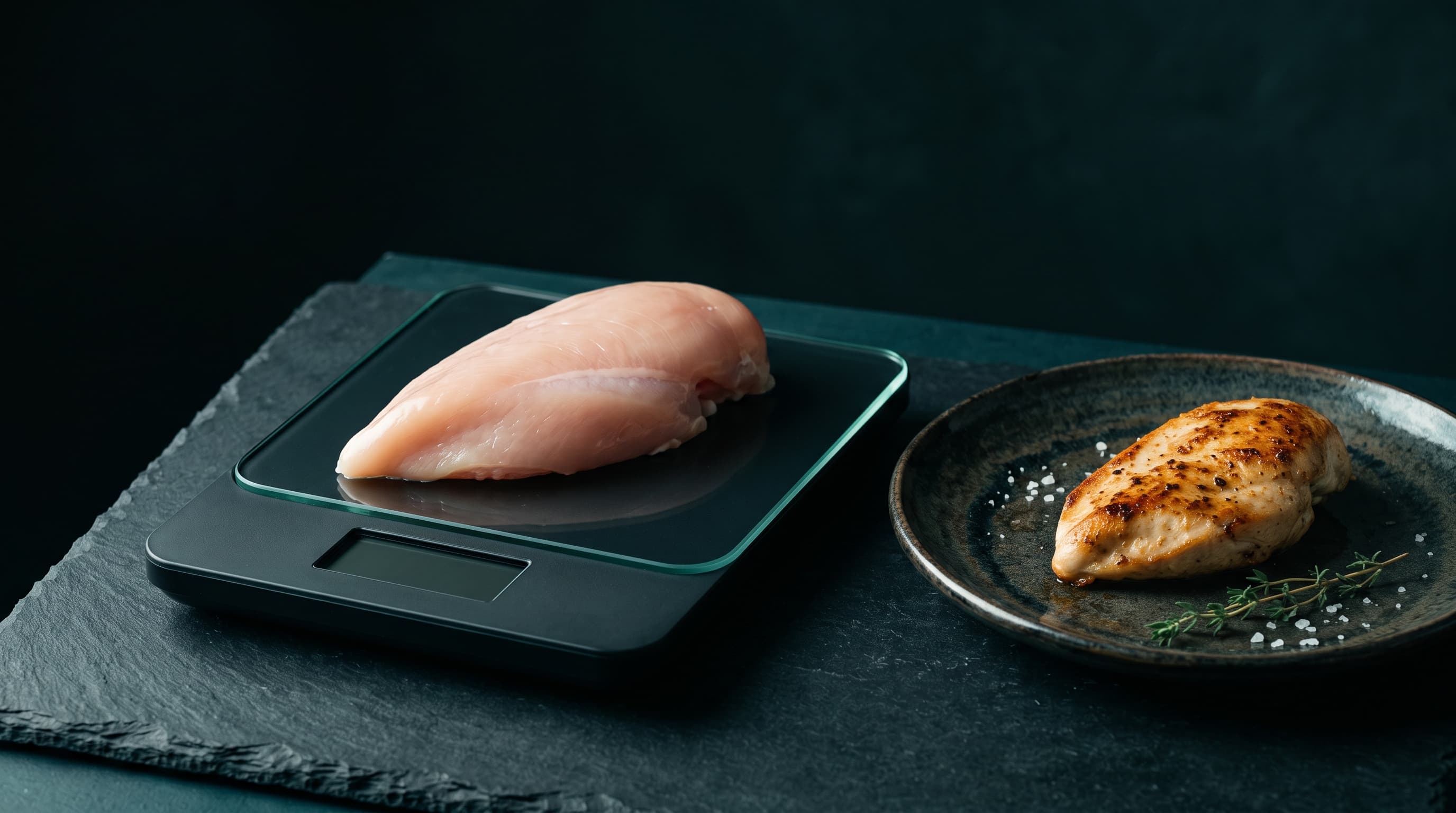
TL;DR: Cooking changes what your food weighs. It does not change how many calories are in it. So the only rule that matters is this: log the state you weighed. Weigh raw, pick the raw entry. Weigh cooked, pick the cooked entry. Mixing the two is the single most expensive tracking mistake there is, and it is worth roughly 90 calories on a chicken breast and 500 or more on a bowl of rice.
Most people who track carefully and still stall are not lying to themselves about the cookies. They are logging a plate of food that weighs one thing and pricing it as if it weighed another.
Here is what actually happens on the pan. A raw chicken breast is roughly 65% water. Cook it and a chunk of that water leaves. The protein, the fat and the calories stay exactly where they were. You started with 100g of chicken at 120 calories and you finished with about 73g of chicken at 120 calories. Nothing was created. Nothing was burned off. The same energy is now packed into less mass, which is why the cooked entry in the database reads 165 calories per 100g instead of 120.
That gap is where the whole problem lives.
The two numbers that trip everyone up
USDA FoodData Central lists skinless chicken breast twice, and both entries are correct:
| State | Calories per 100g | Protein per 100g | |---|---|---| | Raw | 120 | 22.5g | | Roasted | 165 | 31g |
Nobody is being sloppy. They are two different foods by weight because one of them has had a quarter of its water driven off. The mistake is weighing the food in one state and charging yourself at the other state's price.
Say you cook and plate 200g of chicken. Log it against the raw entry and you record 240 calories. You actually ate 330. You just made 90 calories disappear from a single meal. Do that at lunch and dinner every day and you have hidden roughly 65,000 calories over a year, which is somewhere near 18 pounds of fat you cannot account for. That is not a rounding error. That is the entire diet.
Cooking yields worth memorizing
The USDA published a whole reference on this, the Table of Cooking Yields for Meat and Poultry (Agricultural Research Service, 2014), because the shrink is large and it is not the same for every food. Rough working numbers:
| Food | What 100g raw or dry becomes | Direction of the error | |---|---|---| | Chicken breast | ~73g cooked | Cooked logged as raw undercounts | | Lean steak | ~75g cooked | Cooked logged as raw undercounts | | 85% ground beef | ~72g cooked, plus rendered fat | Undercounts, but less than you'd think | | Bacon | ~31g cooked | Massive undercount | | White rice | ~280g cooked | Cooked logged as dry overcounts by ~3x | | Dry pasta | ~230g cooked | Cooked logged as dry overcounts by ~2x | | Rolled oats | ~400g cooked | Cooked logged as dry overcounts badly |
Notice that the direction flips. Meat loses water, so cooked meat is calorie-dense, and mislabeling it makes you undereat your target without knowing. Starches absorb water, so cooked rice is calorie-sparse, and mislabeling it makes you think you ate 900 calories when you ate 325. One error stalls your cut. The other one leaves you underfed and miserable on a bulk.
Ground beef is its own special case. It loses water like any meat, but it also renders fat into the pan, and how much stays behind depends on whether you drained it. If you drain, the cooked product is genuinely leaner than the raw label implied. If you tip the pan back over your rice, it isn't.
The rule, in one line
Weigh in whatever state is convenient, then pick the database entry that matches that state.
Both approaches are accurate when you are consistent. Raw is the better default for one reason: raw weight is a fixed quantity, and cooked weight is a variable that depends on you. Cook the same breast to 165F instead of 155F, leave it on the pan an extra three minutes, use a lid or don't, and the finished weight moves by 10% or more. Raw does not care how you cook. That is the whole argument.
The practical setup: weigh proteins, grains and fats raw before they hit the heat, and log the raw entry. If you cannot weigh raw, weigh cooked and be disciplined about selecting a cooked entry.
The exceptions where cooked is correct
- Packaged foods with a "prepared" panel. If the label declares calories as prepared, use the prepared figure and weigh accordingly. Read which one the box is quoting.
- Restaurant and takeout food. You are estimating anyway. Urban et al. (2011, JAMA) measured 269 restaurant items and found stated energy contents averaged 18% below the real value, with some individual dishes off by far more. Weigh what is in front of you, use a cooked entry, and accept a wider error bar. Our guide to tracking calories when eating out covers the rest of that playbook.
- Someone else cooked it. Same logic. Cooked entry, best guess on the oil.
Batch cooking without breaking the math
This is the part people get stuck on, and the fix is simple arithmetic.
- Weigh every ingredient raw as it goes into the pot, and log the whole batch as one recipe.
- When it's done, weigh the entire finished batch. Write that number down.
- Portion by cooked weight, and treat each serving as its share of the total cooked weight.
If 1,200g of raw ingredients cooks down to 950g and you eat 240g of it, you ate 240 divided by 950, or about 25% of the batch. You never needed a per-100g cooked figure for a mixed dish, and honestly no database has an accurate one for your chili.
Fix the entry, not just the weight
Half of this problem is the food database rather than the scale. Most user-submitted entries in the big apps do not say which state they mean, and plenty of them are simply wrong, which is a documented problem with MyFitnessPal's crowdsourced database. If an entry says "Chicken Breast" with no raw or cooked qualifier and lands at 165 per 100g, that is a cooked entry no matter what the title implies. Read the number, not the name.
Keep it in perspective too. Even trained dietitians underreport their own intake. Champagne et al. (2002) put dietitians and non-dietitians through doubly labeled water and found the professionals were off by about 10%, the amateurs closer to 18%. Getting raw versus cooked right is one of the few tracking errors you can fully eliminate, which is exactly why it's worth eliminating. If the whole exercise still feels like guesswork, we broke down where calorie tracking actually goes wrong, and there's a lighter-touch approach in how to count calories without a food scale.
If you don't know what number you're aiming at in the first place, set the target with the macro calculator before worrying about the third decimal place on a chicken breast.
What to do tonight
Open your log and check three foods you eat constantly. For each one, look at the calories per 100g and decide whether that is the raw or the cooked figure. Then check whether you have been putting raw or cooked grams against it. If those two don't match, you just found more calories than any supplement or extra cardio session was ever going to give you.
Protokl sidesteps the state problem instead of asking you to solve it from a list of ambiguous user entries. Photograph the plate and it estimates what's actually on it, cooked, then reconciles that against your weight trend over time, so a systematic logging bias shows up as a gap between what you logged and what your body did. That's the real backstop: not a more precise entry, but a system that notices when the entries are lying. Try it free.
Sources
- U.S. Department of Agriculture, Agricultural Research Service. FoodData Central. Chicken, broilers or fryers, breast, skinless, boneless, meat only, raw and roasted.
- U.S. Department of Agriculture, Agricultural Research Service (2014). USDA Table of Cooking Yields for Meat and Poultry, Release 2.
- Urban, L. E., et al. (2011). Accuracy of stated energy contents of restaurant foods. JAMA, 306(3), 287-293.
- Champagne, C. M., et al. (2002). Energy intake and energy expenditure: a controlled study comparing dietitians and non-dietitians. Journal of the American Dietetic Association, 102(10), 1428-1432.
- Lichtman, S. W., et al. (1992). Discrepancy between self-reported and actual caloric intake and exercise in obese subjects. New England Journal of Medicine, 327(27), 1893-1898.
Post to Instagram / TikTok
Tap Share, choose Instagram or TikTok, and this 1080×1080 card loads straight into the post composer — ready to publish. Add your caption and point your bio link back here, since links aren’t tappable inside IG/TikTok posts.
Related reading
- How to Track Calories When You Eat Out (Without Guessing)Restaurant meals are where most tracking falls apart. Here's what the research says about menu accuracy, how far off your own estimates are, and a practical system for logging food you didn't cook.
- How to Manage Hunger on a Cut Without Eating More CaloriesHunger is the reason most cuts fail, and it's more controllable than people think. Here's what actually moves appetite at a fixed calorie target: protein dose, food volume, processing level, and sleep.
- How to Count Calories Without a Food ScalePractical methods to track calories without weighing every gram of food. Covers hand-portion estimation, visual cues, plate methods, and AI photo logging as the lowest-friction solution.
Want this as a daily protocol?
Protokl builds personalized workout and nutrition plans around your body composition, goals, and experience level. Science-backed. AI-powered. Syncs with Apple Health.
Get Protokl →