How Many Carbs Do You Need to Build Muscle?
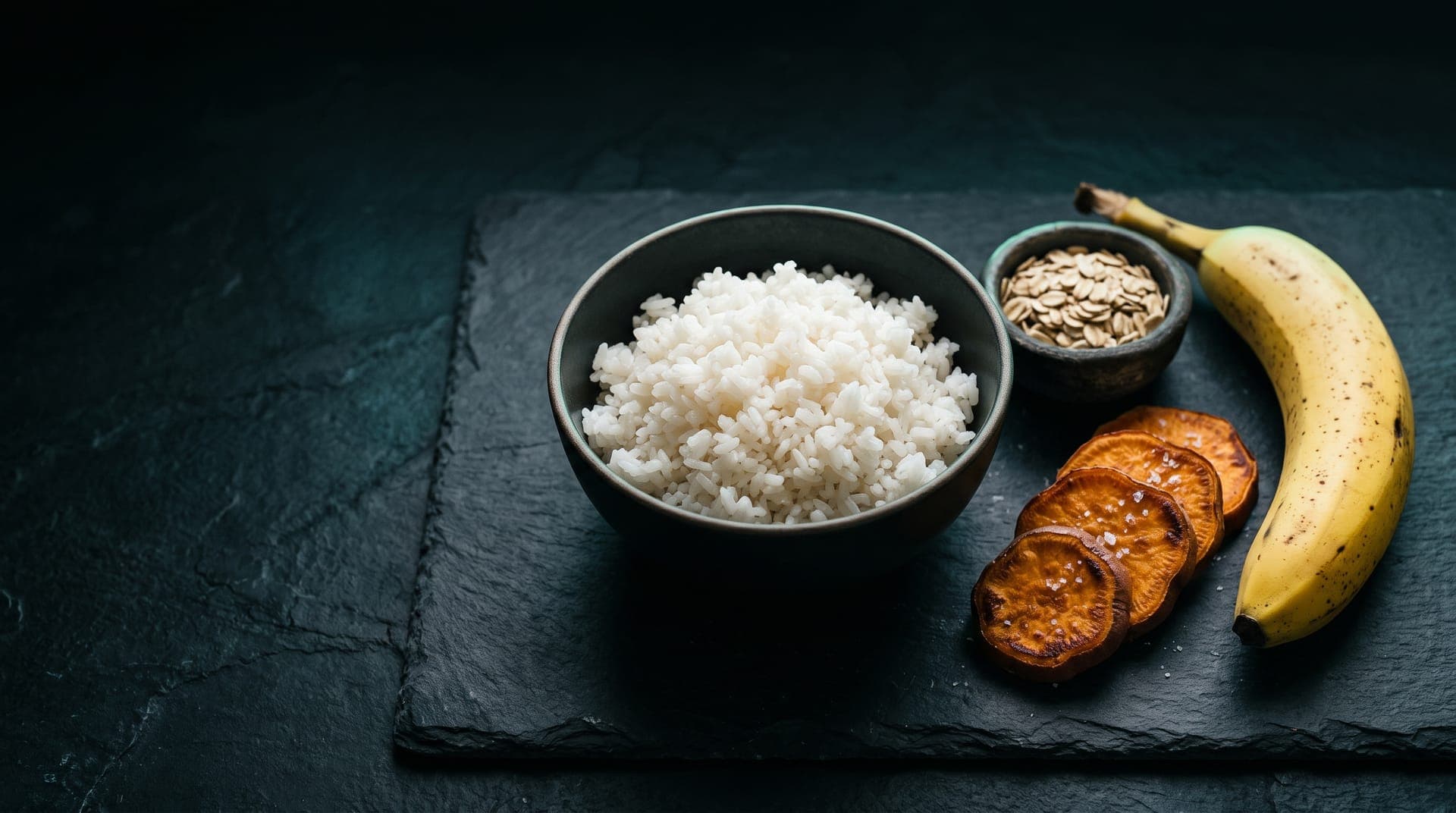
TL;DR: Most lifters build muscle well on 3 to 5 grams of carbohydrate per kilogram of body weight per day, which is about 1.4 to 2.3 g per pound. That's 240 to 400 g for an 80 kg (176 lb) lifter. But carbs are the third priority, not the first. A 2022 systematic review of 49 studies found that extra carbs rarely changed strength or training performance unless the workout was long and high-volume or the lifter was training fasted (Henselmans et al., 2022). Get protein and calories right first, then let carbs fill most of the remaining budget.
Carbs have spent twenty years getting blamed for everything. Then the pendulum swung, and now half of gym culture treats rice as a performance drug. Neither camp is right. Carbohydrate is useful for building muscle, but it's useful in a narrower, more boring way than either side claims.
Here's what the research actually supports, and how to turn it into a number.
The Short Answer: 3 to 5 g per kg
Sports nutrition reviews aimed at strength athletes land in a fairly tight range. Slater and Phillips (2011) suggested 4 to 7 g/kg per day for strength-trained athletes, with the upper end reserved for people doing a lot of total work. A later review focused specifically on bodybuilders in their building phase recommended 3 to 5 g/kg or more, scaled to training volume and personal preference (Iraki et al., 2019).
In practice:
| Body weight | 3 g/kg | 4 g/kg | 5 g/kg | |---|---|---|---| | 60 kg (132 lb) | 180 g | 240 g | 300 g | | 70 kg (154 lb) | 210 g | 280 g | 350 g | | 80 kg (176 lb) | 240 g | 320 g | 400 g | | 90 kg (198 lb) | 270 g | 360 g | 450 g |
If you lift four days a week for about an hour, the lower half of that range is plenty. If you're running six high-volume sessions a week, or you add a lot of cardio, aim higher.
Why Carbs Matter Less Than You've Been Told
The case for carbs usually goes like this: lifting burns glycogen, glycogen fuels performance, so more carbs means better workouts and more growth.
The first part is true. A few sets of a single exercise can drop glycogen in the working muscle by roughly a quarter (MacDougall et al., 1999). The leap from there to "more carbs, more muscle" is where it falls apart.
Henselmans and colleagues (2022) pulled together 49 studies that manipulated carbohydrate intake and measured strength or resistance training performance. The results were pretty deflating for carb maximalists:
- Acute studies: extra carbs helped in 6 of 19 studies. The wins mostly came when the comparison group trained fasted, or when the session ran past about 10 sets per muscle group.
- Short-term studies (2 to 7 days): none of the seven found a benefit.
- Long-term studies: 15 of 17 found no difference in strength or performance between higher- and lower-carb diets.
They also found no dose-response effect. Going from moderate to very high carbs didn't buy anything extra.
Carbs also don't add much to the muscle-building signal after a workout. When researchers added carbohydrate to a post-workout protein dose, muscle protein synthesis didn't rise any further than protein alone (Koopman et al., 2007). Protein is doing the heavy lifting there. That's why your daily protein target matters more than any carb timing trick.
So Why Not Just Go Low-Carb?
Because "carbs don't add much on top" isn't the same as "carbs are optional when you're trying to grow."
The muscle-building case for a ketogenic diet is weak. In one study of resistance-trained women following the same program, the non-keto group gained lean mass while the keto group lost fat but didn't gain muscle (Vargas-Molina et al., 2020). Studies like this are small, but the pattern shows up often enough that keto is a poor fit for a building phase.
There are also three practical reasons to keep carbs reasonably high while you're adding muscle:
- They make a surplus easier to eat. A building phase needs extra energy. Fat is dense, but a diet with 40% of calories from fat gets heavy and unappetizing fast. Rice, oats, potatoes, and fruit are the easiest way to hit a calorie surplus without forcing it.
- High-volume training feels better. The review above found the clearest benefit in sessions with lots of sets. That's exactly what a hypertrophy block looks like. Even if the strength numbers in a lab don't move, sessions that feel less grinding are sessions you actually finish.
- Fiber and micronutrients. Most whole-food carb sources bring fiber, potassium, and magnesium along with them. A low-carb bulk tends to crowd those out.
If you genuinely prefer eating lower carb and you train moderately, you'll still grow. You just don't have a good reason to go below about 2 to 3 g/kg on purpose while you're trying to gain.
How to Set Your Carbs, Step by Step
Think of macros as a budget, set in order of importance.
1. Set calories. For lean gaining, that's maintenance plus roughly 200 to 350 calories a day. If you don't know your maintenance, the macro calculator will give you a starting point, and your scale trend over three to four weeks will tell you if it's right.
2. Set protein. About 1.6 g/kg per day captures nearly all of the muscle-building benefit for most people (Morton et al., 2018). Going up to 2.2 g/kg is a reasonable safety margin.
3. Set a fat floor. Around 0.6 to 1 g/kg keeps hormones and food enjoyment in a good place. Roughly 20 to 30% of calories works for most lifters.
4. Give carbs everything else. Here's an 80 kg lifter eating 3,000 calories:
- Protein: 160 g × 4 = 640 calories
- Fat: 80 g × 9 = 720 calories
- Remaining: 1,640 calories ÷ 4 = 410 g carbs (about 5.1 g/kg)
That lands right at the top of the evidence range without anyone having to pick a carb number out of thin air. If 410 g feels like too much food, shift some of it to fat. The research says you won't lose muscle for it.
Does Carb Timing Matter?
Less than supplement ads suggest. For most lifters training once a day with a meal or two in between, total daily intake is what counts.
Timing starts to matter in a few specific cases:
- You train fasted. This is where the acute studies showed the clearest benefit. A banana or a bowl of oats 1 to 3 hours before lifting is enough.
- Your sessions are long. If you're regularly doing 20+ hard sets in one sitting, carbs before or during the session can help you keep the back half honest.
- You train twice a day. Refilling glycogen between sessions is the one situation where post-workout carbs earn their reputation.
Outside those cases, eat carbs where they fit your day. Pre-workout and dinner is a sensible default.
What About Carbs on Rest Days?
You don't need to slash carbs on rest days. Glycogen is replenished over 24 to 48 hours, and muscle growth runs for at least that long after a session. If you like cycling your intake, a modest swing works fine, but keep weekly calories on target. The calorie cycling guide covers how to do it without accidentally erasing your surplus.
The Bottom Line
Aim for 3 to 5 g of carbs per kilogram of body weight, higher if your training volume is high. But don't treat that number as the main lever. Calories and protein drive muscle growth. Carbs are the macro that makes a surplus easy to eat and hard sessions easier to finish. Set them last, from whatever's left in your budget. For the full gaining playbook, see how to lean bulk.
The tricky part is keeping all three numbers aligned as your weight and training change, because a carb target that made sense at 75 kg is wrong at 82. Protokl sets your calories, protein, carbs, and fat from your actual training load and body-weight trend, adjusts them as you gain, and forecasts how much of the new weight is likely to be muscle. You keep eating to the plan, and the plan keeps up with you.
Post to Instagram / TikTok
Tap Share, choose Instagram or TikTok, and this 1080×1080 card loads straight into the post composer — ready to publish. Add your caption and point your bio link back here, since links aren’t tappable inside IG/TikTok posts.
Related reading
- How to Track Calories When You Eat Out (Without Guessing)Restaurant meals are where most tracking falls apart. Here's what the research says about menu accuracy, how far off your own estimates are, and a practical system for logging food you didn't cook.
- How to Manage Hunger on a Cut Without Eating More CaloriesHunger is the reason most cuts fail, and it's more controllable than people think. Here's what actually moves appetite at a fixed calorie target: protein dose, food volume, processing level, and sleep.
- GZCLP Review: The Best Beginner Program Nobody RecommendsGZCLP fixes the two things that break StrongLifts 5x5: not enough volume and no way to fail gracefully. Here's how the three-tier structure works, where it still falls short, and who should run it.
Want this as a daily protocol?
Protokl builds personalized workout and nutrition plans around your body composition, goals, and experience level. Science-backed. AI-powered. Syncs with Apple Health.
Get Protokl →