Calorie Cycling: Should You Eat More on Training Days?
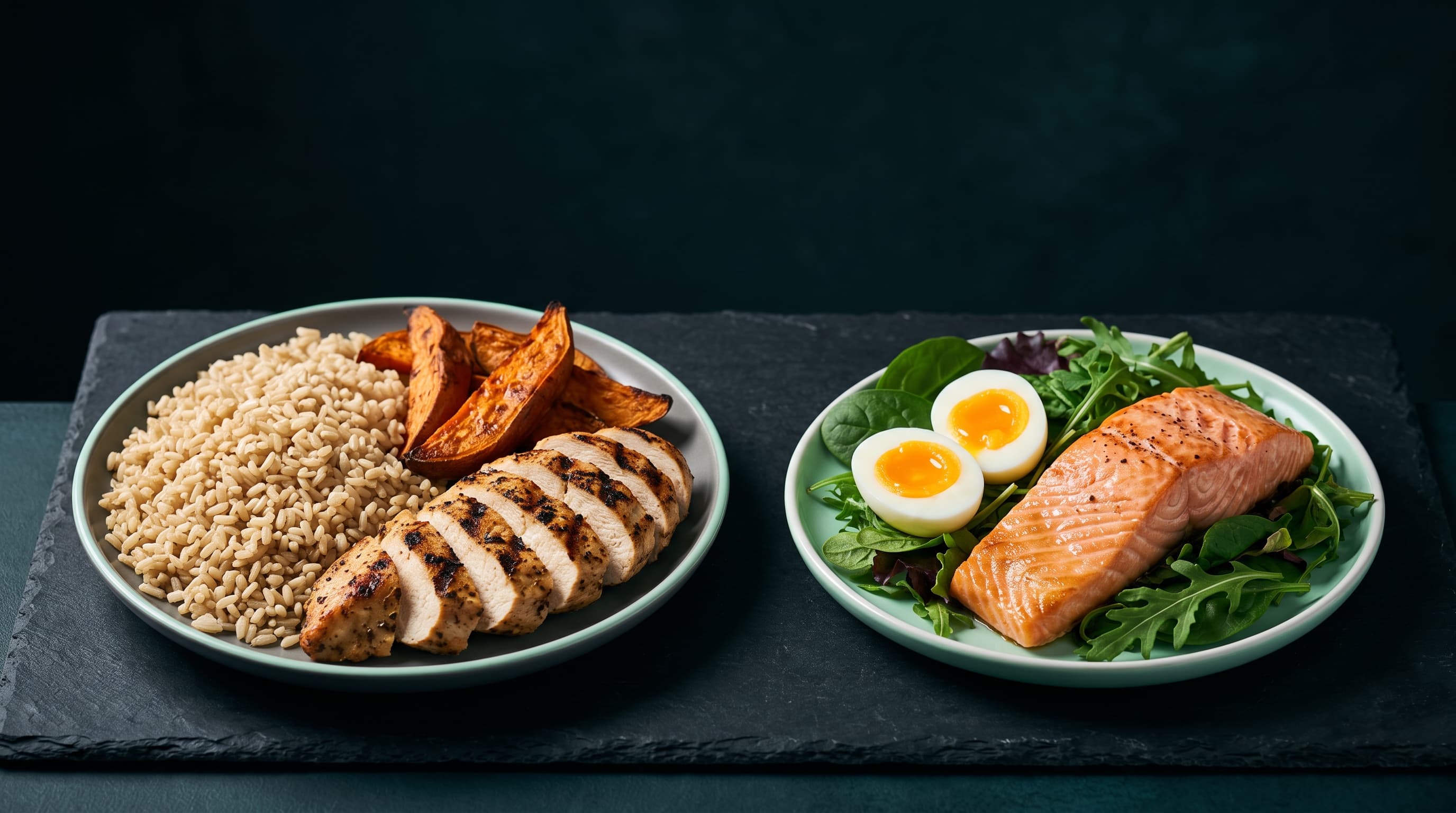
TL;DR: Calorie cycling means eating more on training days and less on rest days while keeping your weekly total the same. The weekly number is what drives fat loss and muscle gain, so cycling is not magic. But structured refeed days can protect muscle and adherence during a cut, and pushing carbs toward training days can help how you train and recover.
You lift four days a week. On those days you are hungry, your workouts feel flat on a deficit, and 1,900 calories feels like nothing. On rest days you are barely moving and that same 1,900 feels like plenty. So the obvious question: why not eat more when you train hard and less when you sit around?
That is calorie cycling. It is one of the few "advanced" nutrition tactics that actually has a logical basis, and it is also one of the most oversold. Here is what it does, what it does not do, and whether you should bother.
What Calorie Cycling Actually Is
Calorie cycling (sometimes called calorie shifting or nutrient timing at the daily level) means varying your daily intake across the week while holding your weekly total constant. A simple version: eat 300 to 500 calories above your daily average on training days, and pull the same amount out on rest days.
The critical word is constant. If you eat maintenance plus 400 on four training days and maintenance minus 400 on three rest days, your weekly average is still roughly maintenance. Cycling redistributes calories. It does not create or erase them.
This matters because fat loss and fat gain are governed by energy balance over time, not by any single day. Your body does not reset at midnight. A 2014 review of metabolic adaptation to dieting made the point plainly: what determines the outcome of a diet is the accumulated energy deficit, not the day to day pattern of how you get there (Trexler, Smith-Ryan and Norton, 2014). So the first honest thing to say about calorie cycling is that it will not out-perform a flat diet on the scale if the weekly totals match.
So Why Do It At All?
Three real reasons, none of them metabolic magic.
Performance and recovery. Carbohydrate is the primary fuel for hard resistance training. When you park more of your carbs on training days, you show up with fuller glycogen stores and usually train better, especially deep into a cut. The International Society of Sports Nutrition's position on natural bodybuilding recommends concentrating carbohydrate around training for exactly this reason (Helms et al., 2014). You are not changing the weekly math, you are spending the calories where they do the most work.
Adherence. Dieting fails on the days it feels unbearable, not on the spreadsheet. For a lot of people, three genuinely tighter rest days are easier to hold when they are bracketed by four days that feel almost normal. A plan you can follow beats a "better" plan you quit in week five.
Muscle protection during a cut. This is where the research gets interesting. Campbell and colleagues (2020) had resistance-trained lifters diet for seven weeks, comparing a continuous deficit against a group that took two higher-calorie "refeed" days each week at maintenance. Total weekly calories were matched. Both groups lost similar fat, but the refeed group held onto more fat-free mass and resting metabolic rate. Structured higher days, placed intelligently, appear to blunt some of the muscle and metabolic cost of dieting.
Daily Cycling vs Block Cycling
It helps to separate two things people lump together.
Daily calorie cycling is the training-day / rest-day pattern above. It is mostly a tool for carb placement and adherence.
Block cycling is dieting in stretches, then stepping back to maintenance for a stretch. The MATADOR study (Byrne et al., 2018) is the standout here: men who dieted in two-week blocks separated by two-week maintenance breaks lost more fat and showed less metabolic slowdown than men who dieted continuously for the same net time in deficit. That is a diet-break protocol, not daily cycling, but it lives on the same spectrum and it is one of the stronger pieces of evidence that intermittently backing off the deficit can pay off. If you want the full breakdown of why your metabolism sags on a long cut, read the truth about metabolic adaptation during dieting.
The takeaway: daily cycling is a fine-tuning tool. Block cycling and diet breaks are the heavier levers if your real problem is a stalled, grinding cut.
How To Actually Set It Up
Start from your weekly calorie target, not a random daily number. If you do not have one yet, calculate maintenance and your deficit first with the macro calculator, then divide across the week.
A practical training-day / rest-day split:
- Set your daily average from your weekly target (weekly calories divided by seven).
- On training days, add 15 to 20 percent of that daily number, almost entirely from carbohydrate.
- On rest days, subtract the same amount, mostly from carbohydrate.
- Keep protein high and flat every single day. This is non-negotiable on a cut. Protein drives muscle retention and satiety, and there is no reason to cycle it. If you are unsure of your number, here is how much protein per day actually holds up in the research.
- Keep fat reasonably steady too, since you need a floor for hormones. Carbohydrate is the lever you move.
Example for someone eating 14,000 calories a week (2,000 average) training four days: training days around 2,300 to 2,400, rest days around 1,600 to 1,700. Same week, different distribution.
If your goal is recomposition rather than a hard cut, the same carb-toward-training logic applies, just centered on maintenance instead of a deficit. The macro framework in body recomposition macros pairs cleanly with a light daily cycle.
Who Should Skip It
Calorie cycling adds tracking complexity for a modest payoff. Skip it if:
- You are new to tracking. Nail a consistent daily target and a solid protein floor first. Cycling on top of shaky logging just adds noise.
- Your adherence is already good on a flat diet. Do not fix what is not broken.
- You cannot resist letting "high day" become "eat whatever" day. Cycling only works if the low days actually stay low. The most common failure mode is banking calories you never claw back, which quietly turns a matched week into a surplus.
That last point is the real risk. Calorie cycling assumes you hit both ends of the range honestly. If you are the kind of tracker who rounds up on high days and forgets on low days, a flat target will serve you better.
The Honest Bottom Line
Calorie cycling does not beat a flat diet on energy balance, because the week is what counts. What it can do is put your carbs where they help you train, make a hard cut easier to stick to, and, in the form of structured refeeds, protect some muscle and metabolic rate along the way. Those are real, if modest, wins.
Whatever pattern you choose, the thing that determines your result is the accumulated weekly balance and whether you actually held your muscle while the fat came off. That is exactly what body recomposition is measuring, and it is genuinely hard to see day to day. Protokl models your calorie targets and forecasts your body composition trajectory from your real training and nutrition data, so you can run a cycled or a flat plan and see, in weeks not guesses, whether it is working. Try it and watch the trend instead of the daily noise.
Post to Instagram / TikTok
Tap Share, choose Instagram or TikTok, and this 1080×1080 card loads straight into the post composer — ready to publish. Add your caption and point your bio link back here, since links aren’t tappable inside IG/TikTok posts.
Related reading
- How to Calculate Your TDEE Accurately (Not Just a Formula)Learn how to calculate your Total Daily Energy Expenditure using the Mifflin-St Jeor equation, why static calculators are often wrong, and how adaptive tracking gives you a more accurate number over time.
- How to Manage Hunger on a Cut Without Eating More CaloriesHunger is the reason most cuts fail, and it's more controllable than people think. Here's what actually moves appetite at a fixed calorie target: protein dose, food volume, processing level, and sleep.
- How to Take Progress Photos That Actually Show ChangeMost progress photos are useless because the lighting, pose, and time of day change more than the body does. Here is the protocol that makes the comparison honest.
Want this as a daily protocol?
Protokl builds personalized workout and nutrition plans around your body composition, goals, and experience level. Science-backed. AI-powered. Syncs with Apple Health.
Get Protokl →