Body Recomposition Macros: How to Set Calories and Protein to Build Muscle and Lose Fat
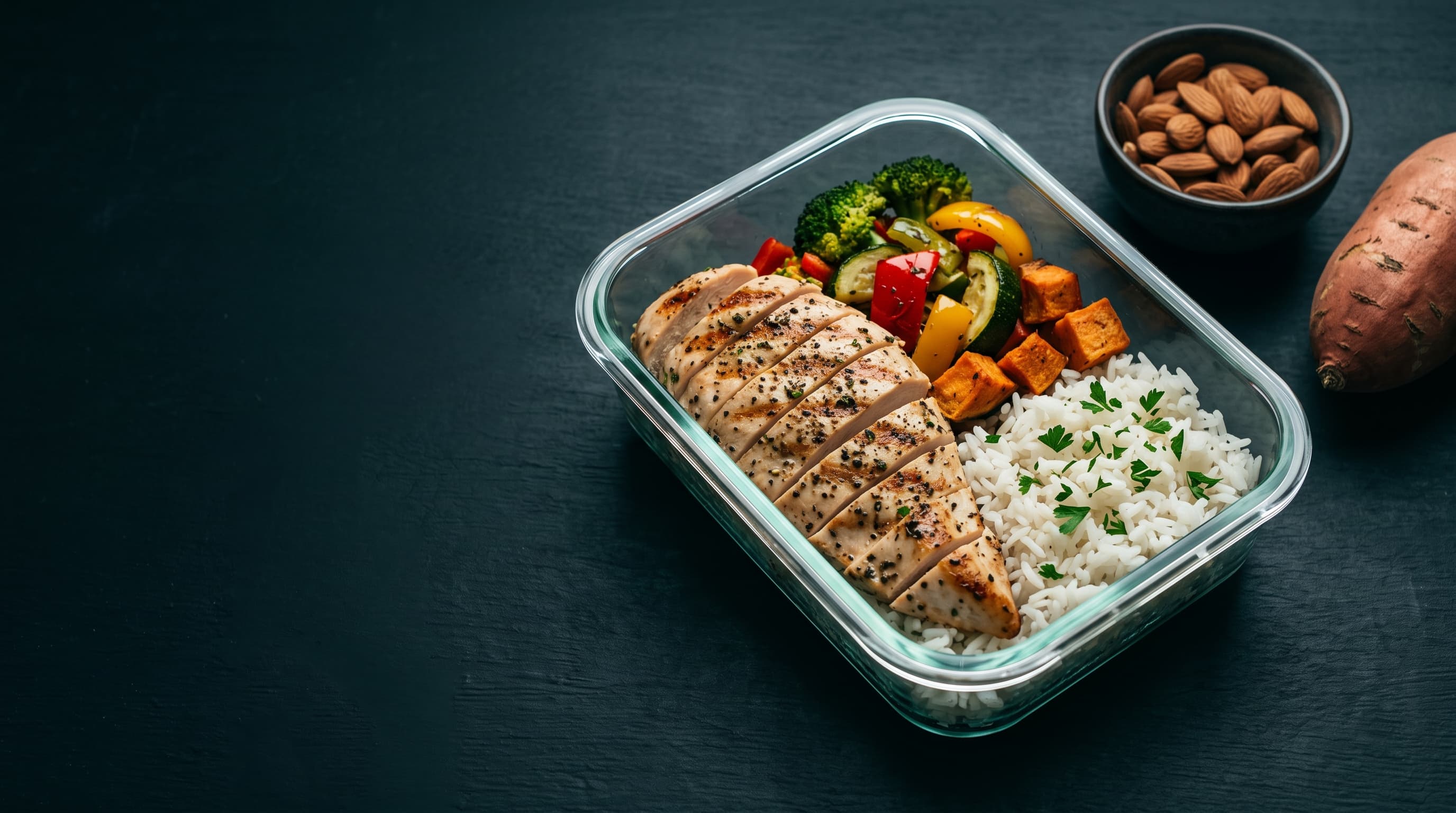
TL;DR: Body recomposition lives or dies on protein and calorie placement. Eat at maintenance or a small deficit (0 to 300 calories under TDEE), push protein to 0.8 to 1g per pound of bodyweight, set fat at a 0.3 to 0.4g per pound floor for hormones, and let carbs take whatever's left to fuel hard training. Shift a few hundred calories toward your lifting days and away from rest days, and let your protein target stay fixed every single day.
Most recomp advice stops at "eat at maintenance and lift." That's correct, and it's also useless, because it doesn't tell you what to put on your plate. The macros are where recomposition actually happens. Get the protein and calorie placement right and your body has a real reason to pull energy out of fat stores while it builds muscle. Get them wrong and you either spin your wheels at maintenance or slide into a deficit deep enough to stall growth.
Here's how to set every number.
Start with Calories: Maintenance, Not Aggressive
Recomposition is a partitioning problem, not a weight-loss problem. You're asking your body to do two opposing things at once, so you can't bury it in a steep deficit. A large cut biases the whole system toward catabolism and makes new muscle nearly impossible.
Set your intake at maintenance to roughly 300 calories below it. The leaner you already are, the closer to maintenance you should sit. If you're carrying more body fat (above ~20% for men, ~30% for women), you can run the bottom of that range because you have more stored energy to partition toward muscle. This is the same logic behind the Forbes relationship: the more fat you carry, the larger the share of any deficit that comes out of fat rather than lean tissue.
If you don't know your maintenance number yet, calculate it first. Our maintenance calorie guide walks through the Mifflin-St Jeor equation and activity multipliers, and the macro calculator does the arithmetic for you. Whatever number you land on, treat it as a starting estimate. Your real maintenance is whatever holds your weight steady over two to three weeks, not what a formula prints.
Protein Is the Non-Negotiable
Protein is the one macro you don't compromise on during a recomp. You're trying to build tissue without a calorie surplus, which means amino acid availability has to make up for the energy you're not providing.
Target 0.8 to 1g of protein per pound of bodyweight. For a 180 lb lifter, that's 145 to 180g a day. The research backs the high end here. Longland et al. (2016) put trained men in a steep deficit and had one group eat 2.4g per kg (roughly 1.1g per pound). That group gained lean mass and lost fat at the same time, while the lower-protein group barely held muscle. Morton et al. (2018), in a large meta-analysis, found gains plateau around 1.6g per kg in a calorie surplus, but a deficit is exactly the situation where erring higher pays off. Helms et al. (2014) reached the same conclusion for lean athletes: the leaner and more calorie-restricted you are, the more protein protects muscle.
Practically, lock your protein number and hit it every day, training or rest, deficit or maintenance. It's the one macro that doesn't flex. If you want the full breakdown of how the number scales with bodyweight and training status, see how much protein per day, or run the protein calculator.
Fat: Set a Floor, Don't Maximize It
Fat gets demonized on cuts and overcorrected on recomps. You need enough to keep hormones running, and not much more, because every gram of fat is a gram of carbs you're not eating to fuel training.
Set a floor of 0.3 to 0.4g of fat per pound of bodyweight, which usually lands around 20 to 30% of total calories. For that 180 lb lifter, that's roughly 55 to 70g a day. Dropping below that floor for extended periods can blunt testosterone and leave you flat and unmotivated. Iraki et al. (2019), reviewing nutrition for natural bodybuilders, recommend keeping dietary fat in this range rather than slashing it to the bone. Hit the floor, then stop. The leftover calories have a better job to do.
Carbs: Whatever's Left, Aimed at Training
Once protein and fat are set, carbs absorb the remaining calories. They're not an afterthought. Carbs fuel the high-quality lifting that drives the muscle-building half of recomposition, and they help shuttle nutrients into muscle around your sessions.
There's no fixed carb target. Subtract protein and fat calories from your daily total, divide the rest by four, and that's your carb number. For most people doing a recomp it ends up somewhere between 1 and 2g per pound. If your training feels sluggish and your weights are stalling, that's usually a sign carbs are too low, not that you need more protein.
Cycle Calories Toward Your Lifting Days
This is the lever most people miss. Instead of eating the same calories every day, push a few hundred extra toward training days and pull them back on rest days. Protein stays fixed; carbs do the moving.
A simple version: eat at maintenance plus 100 to 200 calories (mostly carbs) on lifting days, and at maintenance minus 200 to 300 on rest days. Over the week you net out around maintenance or a slight deficit, but you've concentrated the energy where it does the most good (fueling and recovering from training) and the deficit where it costs the least (rest days, when you're not trying to grow). Barakat et al. (2020), in their review of body recomposition, point to nutrient timing and training-day energy availability as practical levers for partitioning, especially for intermediates who've already used up their newbie-gains window. It's not magic, but it's a free edge.
Don't Chase the Scale
One warning that matters more for recomp than any other goal: the scale will lie to you. When you're losing fat and gaining muscle at similar rates, your bodyweight can sit flat for months while your body changes completely. That's success, not a stall. Track waist measurements, progress photos in the same lighting, and strength in the gym. If the tape is shrinking and the bar is going up while weight holds steady, your macros are working. For the full progress-tracking system, see how to do a mini cut and our broader body recomposition guide.
Putting It Together
For a 180 lb lifter doing a recomp, a typical day looks like this:
- Calories: maintenance to 300 below (say 2,400 on a lifting day, 2,100 on a rest day)
- Protein: 180g, fixed every day
- Fat: 60g, fixed
- Carbs: the remainder, higher on lifting days (~290g) and lower on rest days (~215g)
Set protein and fat as anchors, let carbs flex with your training schedule, and adjust calories based on what the tape and the bar tell you over two to three weeks.
The hard part isn't the math. It's hitting these numbers consistently while life gets in the way, and adjusting them as your maintenance drifts. Protokl handles both: it sets your recomp macros from your stats and goals, splits targets across training and rest days automatically, and recalibrates your maintenance from your real logged data instead of a static formula that goes stale the moment your body changes. Set the targets once, then just hit them.
Post to Instagram / TikTok
Tap Share, choose Instagram or TikTok, and this 1080×1080 card loads straight into the post composer — ready to publish. Add your caption and point your bio link back here, since links aren’t tappable inside IG/TikTok posts.
Related reading
- How to Track Calories When You Eat Out (Without Guessing)Restaurant meals are where most tracking falls apart. Here's what the research says about menu accuracy, how far off your own estimates are, and a practical system for logging food you didn't cook.
- How to Manage Hunger on a Cut Without Eating More CaloriesHunger is the reason most cuts fail, and it's more controllable than people think. Here's what actually moves appetite at a fixed calorie target: protein dose, food volume, processing level, and sleep.
- How to Take Progress Photos That Actually Show ChangeMost progress photos are useless because the lighting, pose, and time of day change more than the body does. Here is the protocol that makes the comparison honest.
Want this as a daily protocol?
Protokl builds personalized workout and nutrition plans around your body composition, goals, and experience level. Science-backed. AI-powered. Syncs with Apple Health.
Get Protokl →