What Body Fat Percentage Do You Need to See Abs?
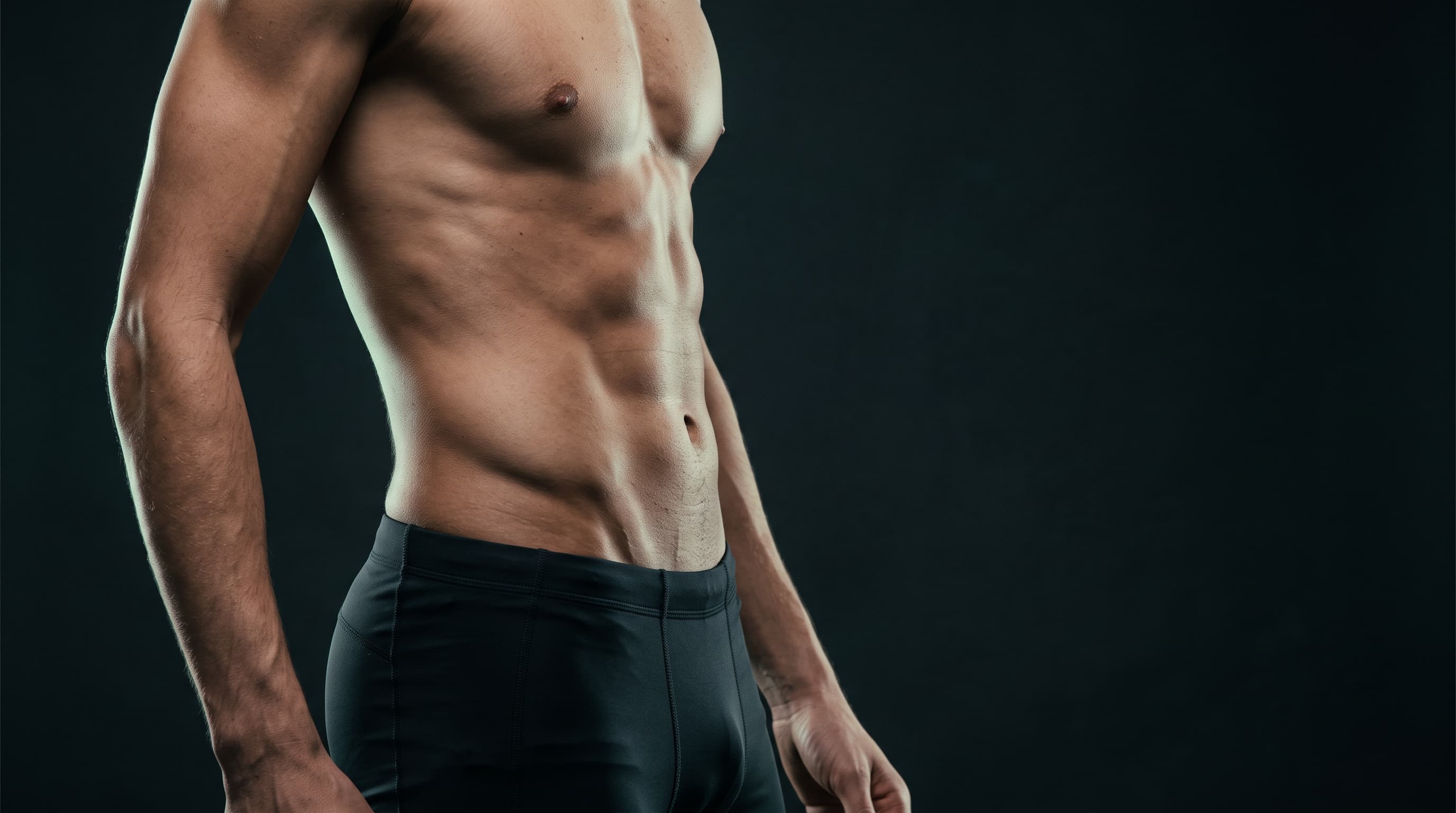
TL;DR: Most men start seeing abs around 12-15% body fat and get a sharp six-pack near 10%. Most women see definition around 18-22% and a lean, defined look near 16-18%. Women need more because they carry more essential fat. You can't crunch your way there. You have to lower total body fat.
Everyone has abs. The rectus abdominis is a muscle you were born with, and it's already there under a layer of fat and skin. Seeing it is almost entirely a question of how thick that layer is. That's the whole reason "how do I get abs" is really the question "what body fat percentage do I need to hit."
So let's answer it directly, then talk about how to actually get there.
The numbers, by sex
Here are the practical ranges. These are where definition tends to appear for most people, not guarantees.
For men:
- 15-19%: Flat, no visible separation. Abs are there but buried.
- 12-15%: Upper abs start to show, especially in good light or after a workout. This is where most guys first notice them.
- 10-12%: A clear, everyday six-pack.
- Below 8%: Deep separation and vascularity. This is stage-lean and hard to hold.
For women:
- 25-31%: Average, healthy range. No visible abs, and that's normal.
- 22-24%: Firm midsection, maybe a faint line.
- 18-22%: Visible upper-ab definition. This is the "athletic and lean" look.
- 16-18%: A defined, clearly visible set of abs.
- Below 15%: Very lean, and for many women this starts to bump into essential-fat territory with hormonal consequences.
These map onto the body composition categories published by the American Council on Exercise, which puts the "fitness" range at roughly 14-17% for men and 21-24% for women, and the athlete range lower still (ACE, 2024). Abs live at the leaner edge of fitness and into the athlete band.
Why women need a higher number
This trips people up, so it's worth being clear. A woman at 20% body fat and a man at 20% body fat do not look the same, and the woman is not "doing something wrong."
Women carry more essential fat, the baseline fat your body needs for hormone production, reproductive health, and organ protection. In men essential fat is around 2-5% of bodyweight. In women it's roughly 10-13% (ACE, 2024). That difference is built into the biology, so every visible-ab threshold shifts up by about 8-10 points for women. Chasing a man's number is not just hard for a woman, it's often unhealthy, and it commonly costs you your menstrual cycle before it gets you a six-pack.
Body fat isn't the only variable
Two people at the same body fat percentage can look different, and it's not random. A few things move the goalposts:
- Muscle thickness. Abs are a muscle. If the rectus abdominis is well developed, it protrudes more and casts more of a shadow, so it shows through at a slightly higher body fat. Ab training doesn't burn belly fat, but it does build the muscle you're trying to reveal, which is a real reason to train them.
- Fat distribution. Some people store fat lower on the abdomen and hold it there stubbornly. The lower abs are almost always the last to show, which is why you'll see a clear four-pack long before the bottom two squares appear.
- Genetics. The connective tissue that divides the abs into "packs" is fixed. Some people have symmetrical eight-packs, some have four, some are slightly offset. You can reveal what you have. You can't redraw it.
- Water and glycogen. Definition fluctuates day to day with sodium, carbs, and hydration. The "whoosh" where abs suddenly appear overnight is usually water shifting, not fat. Read more on why the scale lies about water weight if that swing throws you off.
You can't crunch your way to a six-pack
Spot reduction isn't real. Doing a thousand crunches trains the muscle but doesn't preferentially strip fat from the skin above it. The research on this is old and consistent: targeted ab work builds the muscle without meaningfully changing the fat over it. Visible abs come from lowering total body fat, and the abdomen is often the last place that fat leaves.
That's the part people don't want to hear. The path to abs is a well-run fat loss phase, not an ab routine. Train your abs for strength and thickness, sure, but the reveal is a kitchen-and-calorie job.
How to actually get to your number
If your abs aren't visible, you're above your ab-threshold body fat, and the only real lever is a controlled deficit that protects muscle. The short version:
- Know your starting point. Measurement matters more than you'd think, and no home method is perfectly accurate. Pick one and stay consistent so you're tracking the trend, not chasing a number. Here's how to track your body fat percentage at home, and if the terminology trips you up, start with what lean body mass actually is.
- Set a modest deficit. Aim to lose roughly 0.5-1% of bodyweight per week. Faster than that and you start burning through muscle, which is exactly the tissue you're trying to show off. Our full cut protocol walks through the setup.
- Keep protein high and keep lifting. In a deficit, resistance training plus adequate protein is what tells your body to hold onto muscle while it drops fat. Skip this and you'll get smaller but not more defined, the classic "skinny fat" trap.
- Be patient about the last bit. Going from 18% to 12% as a man, or 24% to 18% as a woman, is a matter of months, not weeks, and the lower abs come last. Expect the finish line to move slower than the start.
Forecast it instead of guessing
Here's where most people get discouraged: they don't know how far they have to go or how long it'll take, so "get abs" stays vague forever and they quit.
That's exactly the problem Protokl was built to solve. It uses your real weight trend and intake to project your body composition forward, so instead of a mystery you get a date. Plug in your current stats and Protokl will estimate what body fat you're at, what pace holds onto your muscle, and roughly when you'll cross the threshold where your abs actually show. If you're curious about the method behind that, we wrote up the science of body composition forecasting.
Abs aren't an ab-workout problem. They're a body fat number, and now you know yours. Set a real target, run an honest deficit, and let the math tell you when you'll get there. See your physique forecast in Protokl.
Sources: American Council on Exercise (ACE). Percent Body Fat Categories and essential fat ranges, 2024. Gallagher D, Heymsfield SB, Heo M, et al. Healthy percentage body fat ranges: an approach for developing guidelines based on body mass index. Am J Clin Nutr. 2000. American College of Sports Medicine (ACSM). Body composition guidelines.
Post to Instagram / TikTok
Tap Share, choose Instagram or TikTok, and this 1080×1080 card loads straight into the post composer — ready to publish. Add your caption and point your bio link back here, since links aren’t tappable inside IG/TikTok posts.
Related reading
- How to Lose Visceral Fat (And How to Know If You Even Have It)Visceral fat is the fat you cannot pinch, and it responds differently to training than the fat you can. Here is how to estimate yours without a scan, and what the trials say actually shifts it.
- How to Break a Weight Loss PlateauStuck at the same weight for weeks? Most plateaus aren't metabolic. Here's how to diagnose the real cause in order, and what to do when adaptation is genuine.
- What Is Lean Body Mass? (And How to Calculate It Correctly)Lean body mass is the body-composition number that actually predicts training outcomes. Here is what it is, how to estimate it, and how to use it to set protein and calories.
Want this as a daily protocol?
Protokl builds personalized workout and nutrition plans around your body composition, goals, and experience level. Science-backed. AI-powered. Syncs with Apple Health.
Get Protokl →