What Is Lean Body Mass? (And How to Calculate It Correctly)
TL;DR: Lean body mass is everything in your body that is not fat (muscle, organs, bone, water) and it is the number you should anchor protein targets, calorie needs, and progress tracking to, not total bodyweight.
Two people can weigh 180 pounds and look completely different. One is 20% body fat with 144 lb of lean tissue. The other is 30% body fat with 126 lb of lean tissue. They eat the same, they train the same, and they still get different results, because the metric that actually drives metabolic rate, strength potential, and recovery is not the scale number. It is the lean portion.
Lean body mass (LBM) is that lean portion expressed in pounds or kilograms. Once you know yours, every number in your training and nutrition plan calibrates to something meaningful instead of an arbitrary bodyweight.
What Lean Body Mass Actually Includes
Lean body mass is total bodyweight minus fat mass. That sounds simple, but the components inside it matter:
- Skeletal muscle: the part most lifters care about, but only about 40-50% of total LBM in a healthy adult (Heymsfield et al., 2015)
- Bone: roughly 10-15% of LBM
- Organs: heart, liver, kidneys, brain, gut, lungs (~15-20% of LBM)
- Water: most of which is intracellular and tracks with muscle mass
- Connective tissue and skin: the remainder
Note that "lean body mass" technically includes a small amount of essential fat that lives inside cell membranes and the nervous system. Some textbooks use fat-free mass (FFM) to mean the strict zero-fat version. In practice, the two terms are used interchangeably in the fitness world, and the difference is small enough that it does not change any decision you make.
Why Lean Body Mass Beats Bodyweight for Every Decision
It Determines Your Metabolic Rate
Resting metabolic rate scales almost linearly with lean body mass, not with total weight. The Katch-McArdle equation makes this explicit: RMR = 370 + (21.6 × LBM in kg). Two men at the same bodyweight but with a 20 lb LBM gap will have RMRs that differ by roughly 200 kcal per day before they take a single step. That is why generic TDEE calculators that use only weight, height, age, and sex are systematically wrong for muscular or under-muscled individuals. See Adaptive TDEE vs Static Calorie Calculators for the full breakdown.
It Sets Your Protein Target
The protein recommendations that actually have evidence behind them are scaled to LBM, not total weight. Phillips and Van Loon (2011) recommended 1.6 to 2.2 g of protein per kg of LBM for athletes building or preserving muscle. For someone with significant body fat, calculating protein from total weight produces a wildly inflated number with no additional muscle-building benefit. From LBM, it produces a target that is achievable and supported by research. Practical numbers are in How Much Protein Per Day to Build Muscle.
It Tracks the Outcome You Actually Care About
When you cut, you want to lose fat without losing muscle. When you bulk, you want to gain LBM without gaining excessive fat. The scale alone tells you neither. A reading of "down 8 lb" could mean 8 lb of fat (great) or 4 lb of fat and 4 lb of muscle (a failed cut). Tracking LBM alongside fat mass turns the scale from a single confusing number into a two-dimensional picture of what is actually changing, the same principle covered in How to Track Body Fat Percentage.
How to Estimate Lean Body Mass
There is no perfect at-home method, but several work well enough to make decisions on. Order them by accuracy and access:
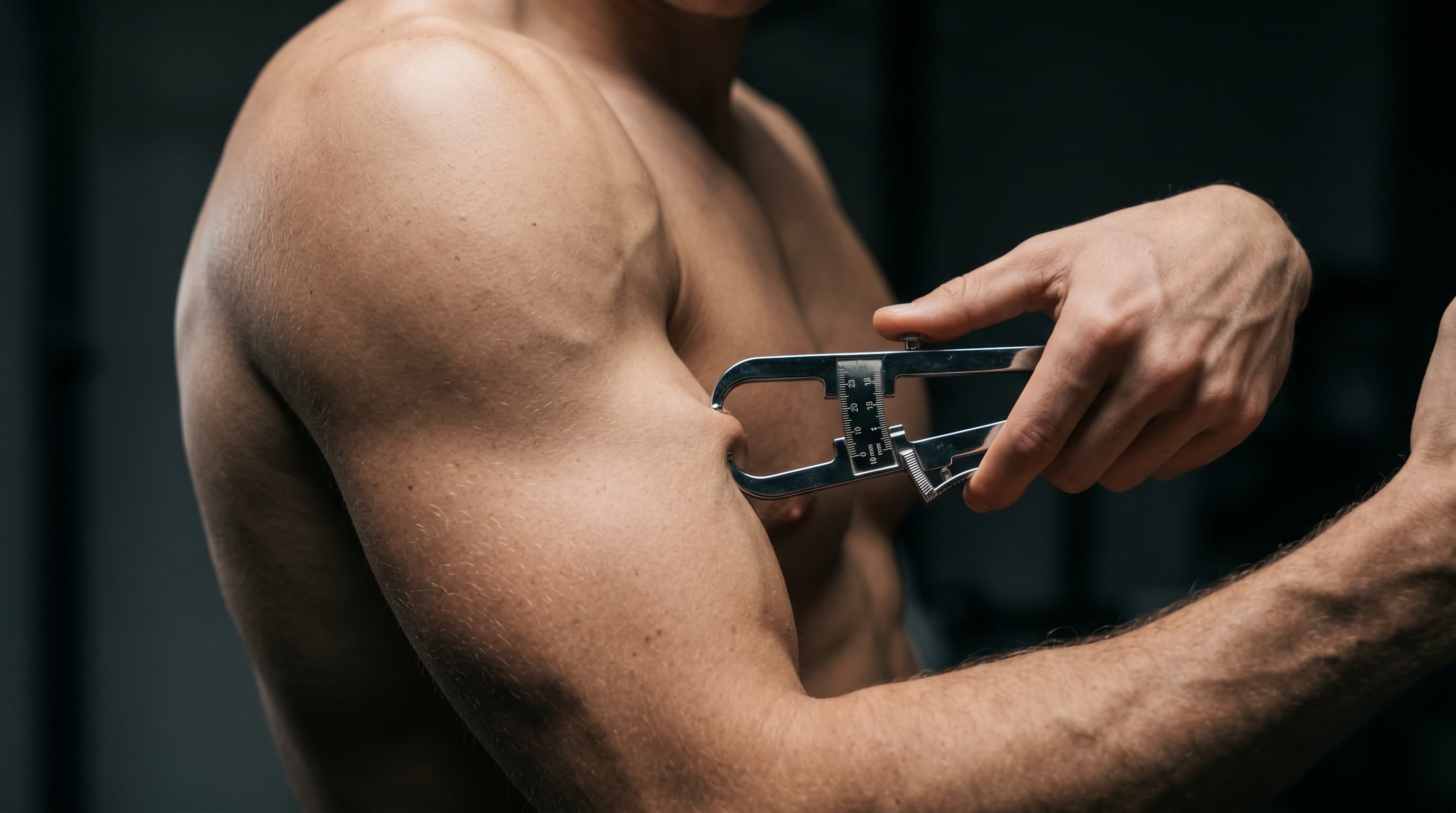
| Method | Accuracy (vs DEXA) | Cost | Practicality | |---|---|---|---| | DEXA scan | reference standard | $50-$150 per scan | quarterly at most | | BodPod (ADP) | ±2% body fat | $50-$100 per scan | regional availability | | Hydrostatic weighing | ±2% body fat | $50-$150 per scan | rare | | Multi-frequency BIA (InBody) | ±3-4% body fat | $20-$80 per scan or gym access | weekly possible | | Skinfold calipers (7-site) | ±3-5% body fat | $25 one-time | daily, requires practice | | Smart scale (consumer BIA) | ±5-8% body fat | $50-$200 | daily, very noisy | | Predictive formulas | ±5-7% body fat | free | daily, no equipment |
Predictive Formulas You Can Use Right Now
For most people, a validated formula is good enough as a starting estimate. The two most commonly cited are:
Boer (1984), recommended for adults with average to higher body fat:
- Men: LBM = (0.407 × weight in kg) + (0.267 × height in cm) − 19.2
- Women: LBM = (0.252 × weight in kg) + (0.473 × height in cm) − 48.3
Hume (1966), slightly older but still widely used:
- Men: LBM = (0.32810 × weight in kg) + (0.33929 × height in cm) − 29.5336
- Women: LBM = (0.29569 × weight in kg) + (0.41813 × height in cm) − 43.2933
These formulas were validated against direct chemical analysis and remain solid for general estimates (Hume, 1966; Boer, 1984). They are not appropriate for very lean athletes or very heavy individuals. At the tails, they systematically over- or under-predict by several pounds. If you have a recent body fat percentage from a caliper or DEXA reading, the direct calculation is more accurate: LBM = bodyweight × (1 − body fat %).
The Practical Approach
Get one accurate baseline measurement (DEXA, BodPod, or a careful 7-site caliper read by someone trained), then track trends with a cheaper daily-access tool (smart scale, gym InBody, or formula). The expensive scan tells you the true number. The cheap tool tells you which direction it is moving. You only need the expensive one every 8 to 12 weeks. The same logic applies to body fat in general; see How to Track Recomp Progress.
How Much Lean Body Mass Should You Have?
There is no single "correct" LBM. It depends on height, frame, sex, training history, and goals. A useful reference point is the Fat-Free Mass Index (FFMI), which normalizes LBM for height (FFMI = LBM in kg ÷ height in m²). Kouri et al. (1995) found that drug-free men cluster around an FFMI of 22 to 23, with a natural ceiling around 25. Women cluster around 17 to 19, with a ceiling around 22.
These are not strict limits, but they are useful sanity checks. If your calculated FFMI is well above 25 as a male or 22 as a female and you have not had genuinely elite training and nutrition for many years, recheck your body fat measurement; the most common cause of a too-high FFMI is an underestimate of body fat.
Common Mistakes When Using LBM
Treating it as more precise than it is. Every estimation method has measurement error of 3 to 8% body fat. A "151.4 lb" LBM reading is not 151.4. It is 145 to 158 with 95% confidence. Track trends over 4 to 6 weeks; ignore week-to-week noise.
Using daily smart-scale BIA without smoothing. Consumer bioelectrical impedance is extremely sensitive to hydration, time of day, food intake, and skin moisture. A daily reading swing of 2 to 3 pounds of "LBM" is almost always hydration, not actual tissue change. Use a 7-day moving average; see Why the Scale Lies About Water Weight for the same principle applied to total weight.
Recalculating protein targets weekly. LBM moves slowly. Building 5 lb of real muscle takes months of training. Recalculate protein and calorie targets every 8 to 12 weeks, not every weigh-in.
Forgetting glycogen and water during cuts. The first 2 to 4 pounds of any cut are glycogen and bound water, which technically register as a drop in LBM on a BIA scale. This is not muscle loss. Wait at least 3 weeks before drawing conclusions about LBM trends on a new diet.
Bottom Line
Lean body mass is the single most useful body-composition number for setting protein, estimating maintenance calories, and tracking real progress. Estimate it once with the best method you can access, then track it with whatever cheaper tool you have weekly, and remember that the trend over a month matters far more than any individual reading.
Protokl tracks both lean body mass and fat mass over time and uses them to forecast your composition 12 weeks out, so you can see whether your current calorie and protein targets are actually pointed at the body you want. Set your macros with our Macro Calculator, and download Protokl to keep the LBM trend honest.
Post to Instagram / TikTok
Tap Share, choose Instagram or TikTok, and this 1080×1080 card loads straight into the post composer — ready to publish. Add your caption and point your bio link back here, since links aren’t tappable inside IG/TikTok posts.
Related reading
- Is BMI Accurate If You Lift? BMI vs FFMI for Muscular PeopleBMI can't tell muscle from fat, so it flags a lot of lean lifters as overweight. Here's what FFMI is, how to calculate it, and which number actually tracks your progress.
- How Accurate Is a DEXA Scan? (What the Number Actually Means)DEXA is the gold standard for body composition in practice, but it's precise rather than perfectly accurate. Here's the difference, how big the real error bars are, and how to scan so your results are comparable.
- Waist-to-Height Ratio: The Body Composition Number That Beats BMIWaist-to-height ratio predicts health risk better than BMI and takes 30 seconds with a tape measure. Here's how to measure it, what the 0.5 cutoff means, and why it's one of the best progress metrics for anyone lifting or cutting.
Want this as a daily protocol?
Protokl builds personalized workout and nutrition plans around your body composition, goals, and experience level. Science-backed. AI-powered. Syncs with Apple Health.
Get Protokl →