Are Smart Scales Accurate for Body Fat? What the Research Says
TL;DR: Smart scales nail your weight but estimate body fat poorly: validation studies show errors of 4-8 percentage points versus DEXA, driven by hydration. Treat the body-fat number as a trend line, never an absolute, and weigh under identical conditions every time.
A smart scale tells you that you are 22.4% body fat this morning and 20.1% three days later. You did not lose four pounds of fat in 72 hours. You drank less water last night. That gap is the whole story of bioelectrical impedance: the weight is real, the body-fat number is a soft estimate dressed up to two decimal places.
Here is what the research actually says, and how to get value from the device anyway.
How a Smart Scale "Sees" Your Fat
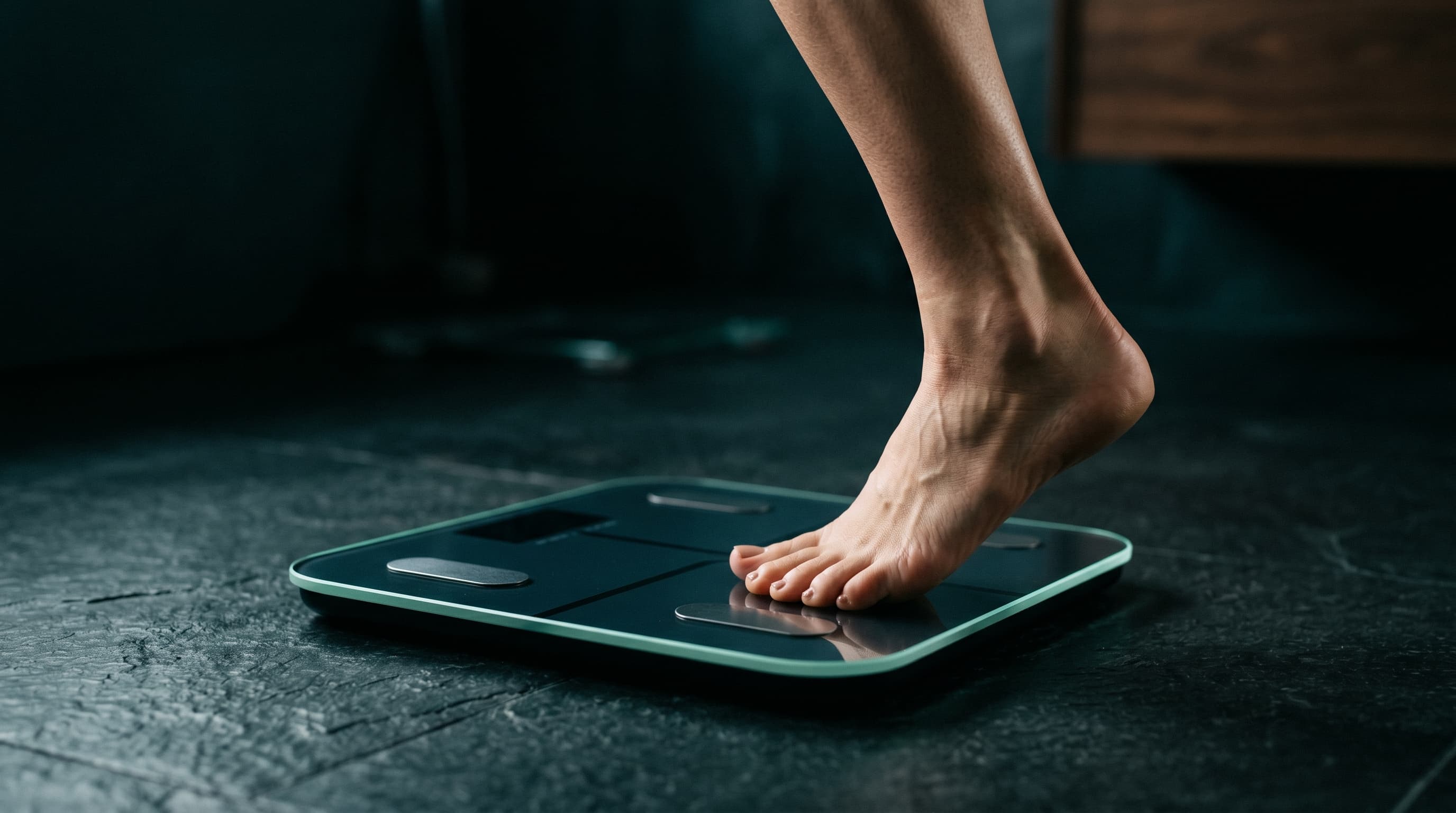
A body-fat scale never measures fat. It measures resistance. When you step on the metal pads, the scale sends a tiny, harmless current up one leg and down the other, then times how much that current is slowed: your impedance. Lean tissue is roughly 73% water and conducts the current easily; fat is largely anhydrous and resists it.
The scale feeds your impedance, plus your height, age, and sex, into a regression equation that predicts fat mass. As Kyle and colleagues laid out in the ESPEN bioelectrical impedance guidelines (Kyle et al., 2004), the entire method is anchored to total body water. That single fact is the source of both its consistency and its biggest weakness.
What the Validation Studies Show
The most useful comparison is against DEXA, the imaging gold standard (covered in our breakdown of body-fat measurement methods, the pillar piece on this topic).
In a 2021 study, Frija-Masson and colleagues tested three popular consumer smart scales against DEXA. The headline split is striking. For body weight, all three scales were excellent: median errors under one kilogram (0 to 0.3 kg). For fat mass, the same scales underestimated by a median of 2.2 to 4.4 kg, and the authors concluded plainly that smart scales "are not accurate for body composition and should not replace DEXA" (Frija-Masson et al., JMIR mHealth and uHealth, 2021).
Other validation work converges on the same range: most consumer models land within about 2 to 5 percentage points of DEXA for an average-composition adult, with errors widening at the extremes: very lean and very high-body-fat users get the worst readings. Stack that against a typical standard error of estimate for BIA equations of roughly 4 to 6 percentage points, and the practical message is blunt. A scale reading of 20% body fat could plausibly be anywhere from about 15% to 25% on DEXA.
That is a range that spans "lean and athletic" to "needs a real cut." Useless as an absolute. Potentially useful as a baseline you track against itself.
Why the Number Jumps Around
Because impedance is really a hydration measurement, anything that shifts your body water shifts the reading:
- Time of day. You are most dehydrated in the morning, most hydrated by evening. Same body, different number.
- Food and drink. A glass of water or a salty meal changes conductance within the hour.
- Carbohydrates. Each gram of stored glycogen binds roughly 3 grams of water. A high-carb day can drop your "body fat" reading overnight. This is the same illusion behind why the scale lies after a refeed or a salty dinner.
- Exercise and sweat. A workout dehydrates you and can swing the estimate several points.
- Skin temperature and foot moisture. Cold, dry feet read differently than warm, damp ones.
None of these changed your actual fat. They changed the water your scale was secretly measuring.
How to Actually Use One
The fix is not a better scale. It is a better protocol. Impedance scales are reliable (they repeat the same answer under the same conditions) even when they are not valid in absolute terms. Reliability is what makes trend tracking work.
- Lock the conditions. Weigh first thing in the morning, after using the bathroom, before eating or drinking, with bare dry feet. Same time, same spot, every day.
- Track the trend, ignore the day. Use a 7-day rolling average. A single reading is noise; the slope across two to three weeks is signal.
- Anchor with photos and tape. Monthly progress photos in consistent lighting and a waist measurement are more honest about body recomposition than any impedance estimate. See our guide to tracking body fat at home for the full stack.
- Calibrate occasionally. If absolute accuracy matters (you are choosing a surgery weight class, a competition, or a medication dose) get one DEXA scan and treat your scale as a relative tracker around that anchor. Our DEXA alternatives guide covers the cheaper validation options.
You can sanity-check any single reading against a population-based estimate using our body fat calculator, which uses tape measurements rather than impedance and is immune to your hydration state.
Smart Scale vs. Photo-Based AI
A newer alternative skips electricity entirely: photo-based AI body composition analysis estimates body fat from progress images. It carries its own error bars, but it has one structural advantage over BIA: it is not fooled by how much water you drank last night, because it reads visual structure, not conductance. Neither method beats DEXA for a single absolute number; both can beat a scale for tracking change, which is what actually matters when you are cutting or recomping.
The Bottom Line
Buy a smart scale for the weight: that part is genuinely accurate and the most important daily input you have. Treat the body-fat percentage as a directional gauge: a 22 that drifts to 19 over six weeks under identical morning conditions is real progress; a 22 that becomes a 19 by Thursday afternoon is just dehydration. The device is a trend line, not a verdict.
Protokl is built around exactly this principle. Instead of trusting any single body-fat reading, it smooths your weight and composition data into a trend, layers in photo-based body composition analysis, and forecasts where your lean and fat mass are actually heading, so you make decisions on the slope, not on this morning's hydration noise.
Track your real body composition trend with Protokl, and use the body fat calculator for a hydration-proof baseline.
Post to Instagram / TikTok
Tap Share, choose Instagram or TikTok, and this 1080×1080 card loads straight into the post composer — ready to publish. Add your caption and point your bio link back here, since links aren’t tappable inside IG/TikTok posts.
Related reading
- What Is Lean Body Mass? (And How to Calculate It Correctly)Lean body mass is the body-composition number that actually predicts training outcomes. Here is what it is, how to estimate it, and how to use it to set protein and calories.
- How to Measure Body Fat Percentage: DEXA vs Calipers vs VisualCompare body fat measurement methods. Learn which is most accurate (DEXA), which is cheapest (visual), and how each method compares.
- How Accurate Is an InBody Scan? What the Research Actually ShowsAn InBody scan is far more precise than it is accurate. Validation studies show it can miss true body fat by several points versus DEXA, yet track change almost perfectly. Here is how to use that.
Want this as a daily protocol?
Protokl builds personalized workout and nutrition plans around your body composition, goals, and experience level. Science-backed. AI-powered. Syncs with Apple Health.
Get Protokl →