How to Lose Visceral Fat (And How to Know If You Even Have It)
TL;DR: Visceral fat is the fat packed around your organs, not the fat under your skin, and it behaves like a different tissue. The good news is that it comes off first. In a deficit, or with a new training stimulus, visceral fat mobilises faster than subcutaneous fat, which is why your waist often shrinks before the scale moves much. You do not need a DEXA to track it. Waist-to-height ratio under 0.5 is the practical target. Aerobic training, a modest calorie deficit and seven-plus hours of sleep are the three levers with actual trial evidence behind them.
There are two kinds of belly fat and they are not the same tissue doing the same job.
Subcutaneous fat is the layer you can pinch. It sits between skin and muscle, it is what a caliper measures, and it is mostly a storage problem. Visceral fat sits deeper, behind the abdominal wall, wrapped around the liver, intestines and pancreas. You cannot pinch it. You cannot see it directly. And unlike the fat on your hips, it is metabolically loud: it drains straight into the portal vein and feeds free fatty acids and inflammatory signalling into the liver.
That is why two people at the same body fat percentage can have very different metabolic profiles. It is also why the guy with a hard, protruding gut is often in worse shape than the softer guy who weighs more.
The part nobody tells you: it comes off first
Here is the useful bit. Visceral fat is not stubborn. It is the opposite.
Ross et al. (2000) ran a randomised controlled trial in Annals of Internal Medicine with 52 obese men split four ways: diet-induced weight loss, exercise-induced weight loss, exercise with no weight loss, and a control. The interesting group was the third. Men who trained but deliberately ate enough to hold their body weight steady still lost abdominal and visceral fat, and those visceral reductions alone tracked with improvements in glucose tolerance and insulin sensitivity.
Weight did not move. The dangerous fat did.
Verheggen et al. (2016) found the same pattern across 117 studies and 4,815 participants comparing exercise training against hypocaloric dieting. Dieting produced more weight loss, as you would expect. Exercise showed a trend toward a larger reduction in visceral adipose tissue despite the smaller weight change.
The practical translation: if your waistband is loosening faster than your scale weight says it should, that is not a measurement error. That is visceral fat leaving first, and it is the change that matters most for your bloodwork.
This is the same reason the scale lies during the first few weeks of a cut. The number you are watching is the one with the worst signal-to-noise ratio in the whole system.
How to estimate it without a scan
A CT or MRI gives you an actual visceral area in square centimetres. Nobody is getting one of those every fortnight, and you do not need to. Waist circumference is the best single field proxy for visceral adipose tissue, and it tracks change over time well enough to run a plan off.
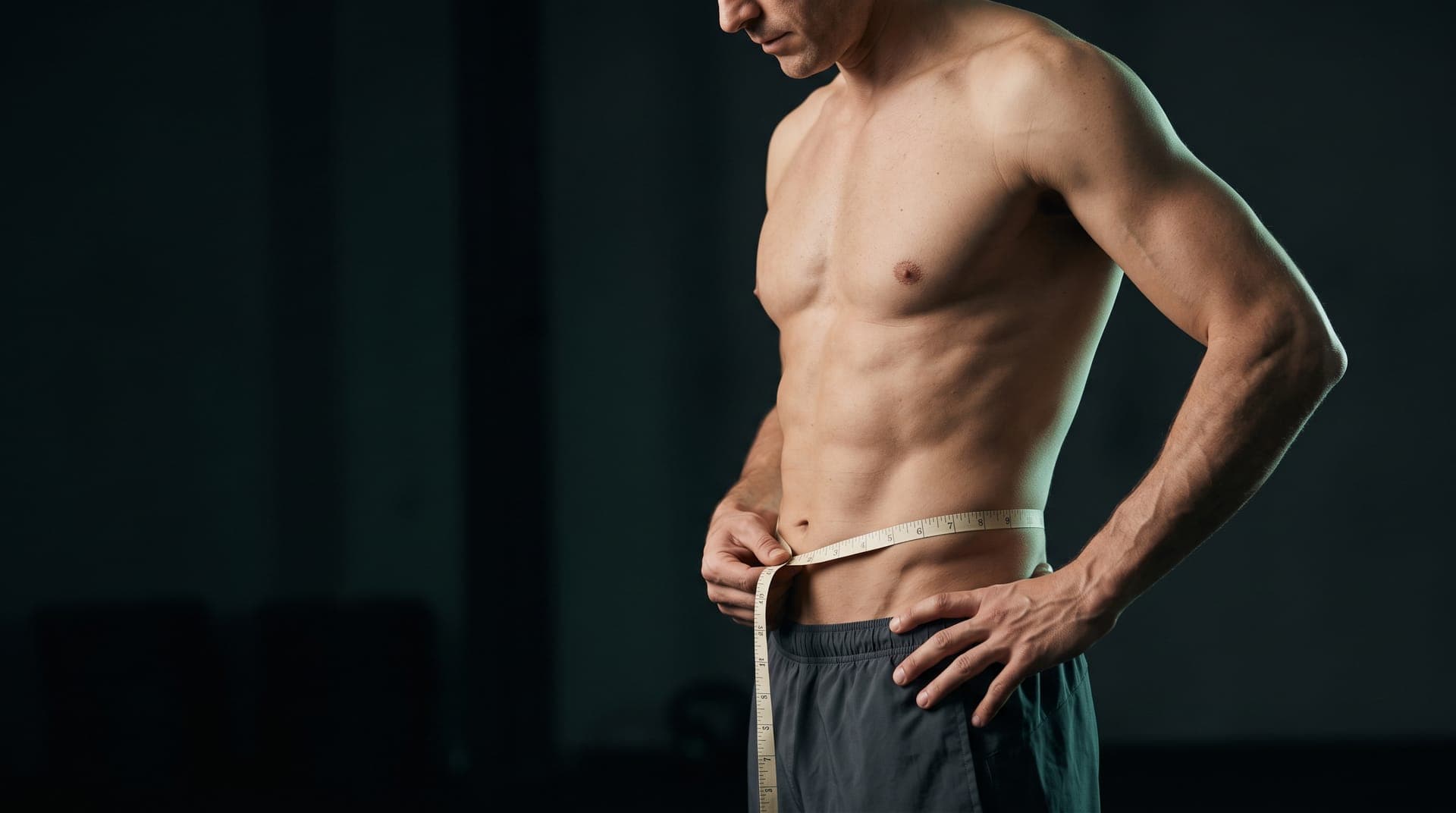
Do it like this. Measure at the level of your navel, standing, at the end of a normal exhale, tape snug but not compressing skin. Same time of day, ideally first thing, before food. Then divide by your height in the same units.
| Waist-to-height ratio | Reading | |---|---| | Under 0.45 | Lean, low visceral load | | 0.45 to 0.50 | Healthy range | | 0.50 to 0.55 | Elevated, worth acting on | | Over 0.55 | High, this is the priority |
The 0.5 line is the one to remember. Keep your waist under half your height and you have cleared the threshold where visceral accumulation starts driving metabolic risk.
Waist-to-height beats BMI badly here, and it beats it worst for the people reading this. BMI counts your lat width and quad mass against you. A ratio built on waist and height does not, which is why BMI is close to useless once you lift seriously.
Track the ratio weekly alongside your weight, not instead of it. The divergence is the signal. Weight flat and waist shrinking means you are recomposing. Weight falling and waist flat usually means your deficit is too aggressive and you are paying for it in lean mass.
What actually moves it
Aerobic training does the heaviest lifting. This is the one modality with direct visceral evidence rather than inference from total fat loss. Maillard et al. (2018) pooled 39 studies and 617 subjects in Sports Medicine and found high-intensity interval training significantly reduced visceral fat mass, running producing a stronger effect than cycling. Effect sizes are modest per study but consistent, and they show up even when total body mass barely changes.
Intervals or steady state, both work. Steady state is easier to recover from and easier to stack alongside lifting, which matters if you are also holding muscle. Zone 2 is the version that does not interfere with your training.
A modest deficit does the rest. Energy balance is still the lever that determines total fat loss, and visceral fat is drawn down disproportionately early in a deficit. You do not need a savage one. 300 to 500 calories below maintenance is enough, and it lets you keep training hard enough to protect lean mass. Work out your actual number with the cut calculator rather than guessing.
Sleep is not a soft variable here. Covassin et al. (2022) ran a 21-day inpatient crossover study in the Journal of the American College of Cardiology with healthy, non-obese adults. Fourteen days on a four-hour sleep opportunity versus a nine-hour one. The restricted condition produced a 9% increase in total abdominal fat area and an 11% increase in visceral fat specifically, alongside an extra 308 calories of daily intake.
Two weeks. Healthy young people. An 11% visceral increase, running in the wrong direction, from a variable most lifters treat as optional. Sleep does more for your body composition than any supplement you are considering, and it is the first thing people trade away.
Alcohol deserves a specific mention. It is not just the calories. Ethanol is metabolised in the liver, which is the organ visceral fat drains into, and heavy intake is independently associated with central adiposity. If your waist is the number you are trying to move, this is the habit to audit first.
What does not move it
Abdominal exercises. Not a single one, not in any volume.
Crunches, planks and ab wheels train the muscle underneath the fat. They do not preferentially mobilise the fat on top of it or behind it, and spot reduction has failed every time it has been tested properly. Train your abs because a strong trunk is worth having, not because you expect the tape to move.
Waist trainers and sweat belts do nothing to the tissue in question. Water leaving your skin does not remove fat from behind your abdominal wall, and the circumference change reverses as soon as you drink.
The actual protocol
Nothing exotic here, which is the point.
- Measure waist and height once, get your ratio, write it down. Your baseline, and the only number in this post you need to act on.
- Set a deficit of 300 to 500 calories. Enough to move, small enough to train through.
- Add three to four aerobic sessions a week. Thirty to forty minutes conversational, or swap two for intervals if you are short on time.
- Keep lifting. Fat loss without resistance training costs lean mass, and lean mass is what decides how your waist looks at any given weight.
- Protect seven hours of sleep like it is a training session. On the evidence above, it is.
- Re-measure weekly, same conditions. Expect a centimetre every two to three weeks early on, slowing after that.
Give it eight weeks before you judge it. Visceral fat moves fast in relative terms, but the absolute amounts are small and week-to-week tape noise is real. One reading tells you almost nothing. Eight of them tell you everything.
Why the trend matters more than the number
The failure mode here is not effort. It is that people measure once, dislike the number, then measure again six weeks later hoping it moved. Two data points with a gap in the middle is not a trend, it is a before-and-after photo with worse resolution.
What you want is a line. Waist, weight and body fat estimate plotted together, week over week, so you can see which one is diverging and correct it while the correction is still small. Tracking recomp progress is mostly about capturing enough points to read the slope.
Protokl holds that line for you. You log the tape measurement and the weight, it plots them against where your composition is actually headed, and a divergence shows up in the curve weeks before it shows up in the mirror. The tape measure does the work. The app makes sure you can read what it is telling you.
Post to Instagram / TikTok
Tap Share, choose Instagram or TikTok, and this 1080×1080 card loads straight into the post composer — ready to publish. Add your caption and point your bio link back here, since links aren’t tappable inside IG/TikTok posts.
Related reading
- How to Break a Weight Loss PlateauStuck at the same weight for weeks? Most plateaus aren't metabolic. Here's how to diagnose the real cause in order, and what to do when adaptation is genuine.
- What Is Lean Body Mass? (And How to Calculate It Correctly)Lean body mass is the body-composition number that actually predicts training outcomes. Here is what it is, how to estimate it, and how to use it to set protein and calories.
- How Long Does It Take to Lose 1% Body Fat? (The Real Math)Most people drop one point of body fat every 2 to 4 weeks on a well-run cut. Here's the math behind that number, why it changes as you get leaner, and why your scale can't show it week to week.
Want this as a daily protocol?
Protokl builds personalized workout and nutrition plans around your body composition, goals, and experience level. Science-backed. AI-powered. Syncs with Apple Health.
Get Protokl →