How Much Fiber Should You Eat for Fat Loss? (The Number Most Cuts Miss)
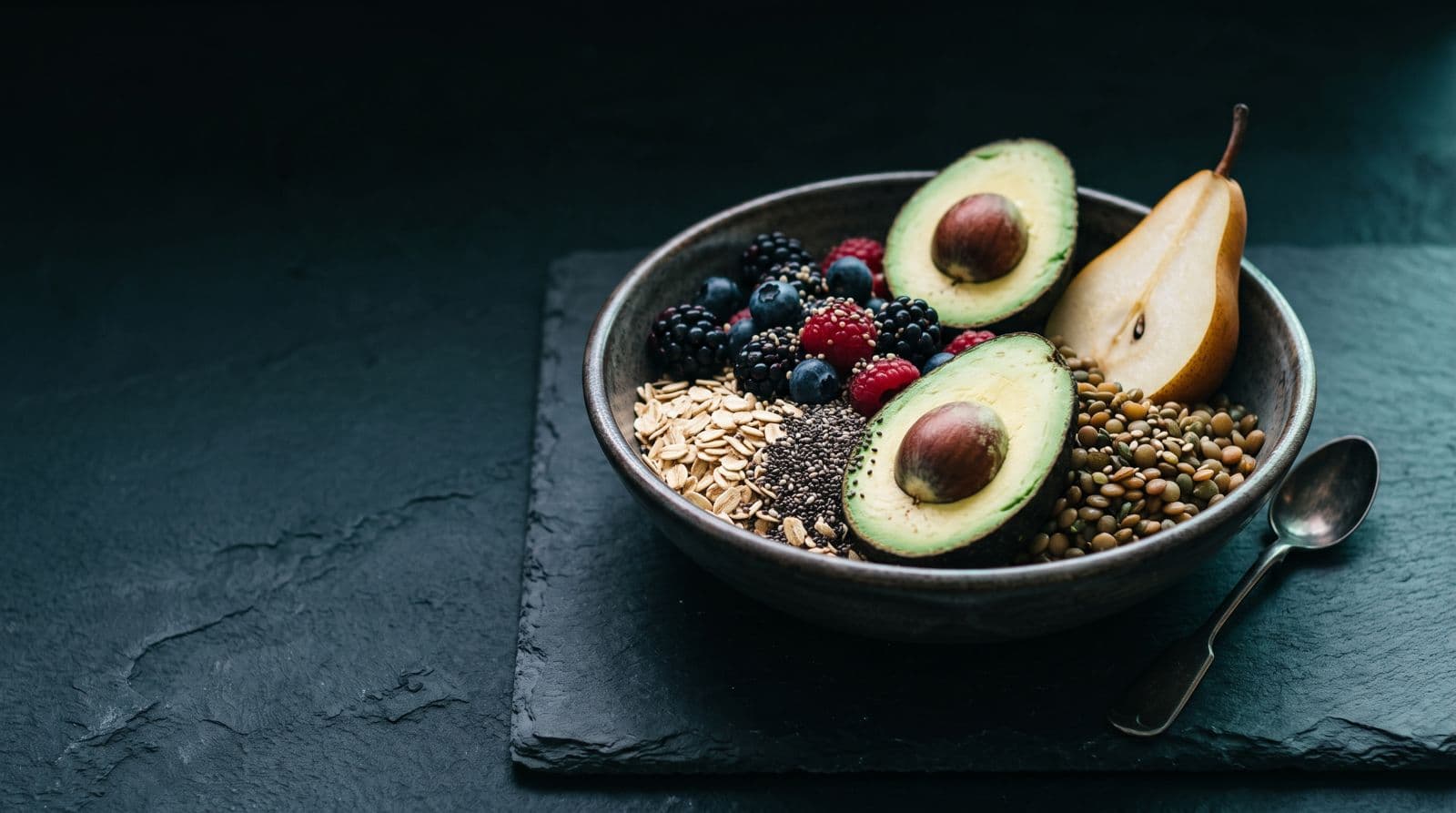
TL;DR: Eat about 14 g of fiber for every 1,000 calories. On a typical cut that's 25 to 35 g a day, roughly double what most people actually eat. Fiber won't melt fat on its own, but it makes the deficit easier to hold, and holding the deficit is the whole game.
Most people set up a cut by picking calories, then protein, then splitting the rest between carbs and fat. Fiber never gets a line. That's a mistake, because when researchers went looking for what separated the people who lost weight from the people who didn't, fiber kept showing up.
What the research actually found
The clearest data comes from the POUNDS Lost trial, a large study that put 345 adults on calorie-restricted diets with different macro splits for six months. When Miketinas et al. (2019) went back through the data, the strongest predictor of weight loss wasn't which macro split someone was assigned. It was how much their fiber intake went up. Each extra 4 g of daily fiber was associated with roughly another 3 pounds lost over six months, and that held regardless of diet type.
The same analysis found that people who ate more fiber also stuck to their assigned diet better. That's the important part. Fiber probably isn't doing most of the fat loss directly. It's making the plan easier to follow, which is where cuts are won or lost.
Zoom out further and the picture is consistent. A large Lancet review of observational studies and trials found the best health outcomes at 25 to 29 g a day, with benefits still climbing above that, plus lower body weight in the trial data (Reynolds et al., 2019). Meanwhile, the average American adult eats around 15 to 16 g (Quagliani and Felt-Gunderson, 2017). Most people are leaving the easiest lever untouched.
How much fiber you need on a cut
The cleanest rule is the one the Institute of Medicine uses to set its guidelines: 14 g of fiber per 1,000 calories (Institute of Medicine, 2005).
| Daily calories | Fiber target | |---|---| | 1,600 | ~22 g | | 2,000 | ~28 g | | 2,400 | ~34 g | | 2,800 | ~39 g |
Scaling to calories matters on a cut. Your intake drops, but your need for fullness goes up, so don't let fiber fall with it. If you're in a deficit, treat 25 g as the floor and the table as the target. If you don't know your calorie number yet, get it from the macro calculator first, then work out fiber from there.
There's no strong reason to chase 60 g. Past roughly 40 to 50 g, most people get more bloating than benefit, and very high-fiber diets can make it harder to eat enough protein because you're simply too full.
Why fiber makes a deficit easier
Three mechanisms, in rough order of how much they matter.
1. Fullness per calorie. High-fiber foods take up space, take longer to chew, and viscous soluble fibers (oats, beans, chia, psyllium) slow how fast your stomach empties. Reviews of the satiety research find the effect is real but most reliable once intake gets above about 25 g a day (Clark and Slavin, 2013). It stacks with protein, which is why the two together are the backbone of managing hunger on a cut.
2. Fewer calories actually absorbed. This one surprises people. In controlled feeding studies, higher-fiber diets reduced how many calories the body absorbed from the same food. Baer et al. (2014) found measurably lower metabolizable energy on a higher-fiber diet, and Karl et al. (2017) found a whole-grain diet produced a net gain of about 92 calories a day, through more energy lost in stool and a small bump in resting metabolism, compared with refined grains. Ninety-odd calories won't transform a cut, but it's a free 10 to 20 percent of a typical daily deficit.
3. Food quality comes along for the ride. You basically can't hit 30 g of fiber eating ultra-processed food. Getting there forces vegetables, fruit, legumes, and whole grains onto the plate, which crowds out the calorie-dense stuff that makes deficits miserable.
How to hit 30 grams without blowing your macros
Here's what a 30 g day looks like using normal food:
- Breakfast: 50 g oats with 100 g raspberries and a tablespoon of chia (about 14 g)
- Lunch: Chicken and a cup of black beans over greens (about 9 g)
- Snack: One medium pear (about 6 g)
- Dinner: Salmon with 150 g broccoli and a small potato with the skin on (about 6 g)
That's 35 g with plenty of protein and nothing exotic. A few rules make it easier:
- Berries and pears beat bananas. Raspberries carry about 6.5 g of fiber per cup for around 65 calories. Low calorie per gram of fiber is what you want on a cut.
- Legumes are the cheat code. Lentils and beans bring 7 to 8 g per half cup plus protein. If you only change one thing, add a serving a day.
- Keep skins on. Potatoes, apples, and pears lose a big chunk of fiber when peeled.
- Psyllium is a decent backup. A teaspoon adds around 4 to 5 g. Use it to close a gap, not as a substitute for real food.
Fiber also has a tracking quirk worth knowing: labels count it inside total carbs, and some of it contributes fewer calories than regular carbohydrate. Don't bother subtracting "net carbs." Track total carbs and total calories, hit your fiber target, and let your weight trend tell you whether the numbers are right. If you're new to reading labels for this, how to track macros as a beginner covers the basics.
Ramp up slowly or regret it
Going from 15 g to 35 g overnight is a reliable way to feel terrible for a week. Add about 5 g every few days so you reach your target over roughly two weeks, and drink more water as you go, because soluble fiber pulls water into the gut. Some extra gas early on is normal and fades as your gut bacteria adjust.
One caveat on the scale: more fiber means more food mass sitting in your digestive tract, which can add a pound or so of scale weight in the first week. That's not fat. It's the same kind of noise covered in why the scale lies, and it washes out in the trend.
Where fiber fits in your cut
Fiber is a support lever. The deficit still does the fat loss, and protein still protects your muscle. Set those first using a proper cutting macro setup, then add fiber as the thing that makes the plan livable through week eight instead of collapsing in week three.
The hard part isn't knowing the number. It's seeing it. Almost nobody tracks fiber, so almost nobody knows they're eating 14 g a day. Protokl logs fiber alongside your macros automatically when you scan a barcode or snap a photo of your meal, shows you where you stand against a target scaled to your calories, and adjusts those calories off your real weight trend. If your last cut ended because you were hungry all the time, check your fiber before you blame your willpower.
Post to Instagram / TikTok
Tap Share, choose Instagram or TikTok, and this 1080×1080 card loads straight into the post composer — ready to publish. Add your caption and point your bio link back here, since links aren’t tappable inside IG/TikTok posts.
Related reading
- How to Manage Hunger on a Cut Without Eating More CaloriesHunger is the reason most cuts fail, and it's more controllable than people think. Here's what actually moves appetite at a fixed calorie target: protein dose, food volume, processing level, and sleep.
- How to Track Calories When You Eat Out (Without Guessing)Restaurant meals are where most tracking falls apart. Here's what the research says about menu accuracy, how far off your own estimates are, and a practical system for logging food you didn't cook.
- How to Train in a Calorie Deficit (Without Losing What You Built)The program isn't what decides whether you keep muscle on a cut. The size of the deficit is. Here's what the training research actually supports: deficit ceiling, volume floor, protein target, and realistic performance expectations.
Want this as a daily protocol?
Protokl builds personalized workout and nutrition plans around your body composition, goals, and experience level. Science-backed. AI-powered. Syncs with Apple Health.
Get Protokl →