Compound vs Isolation Exercises: Which Builds More Muscle?
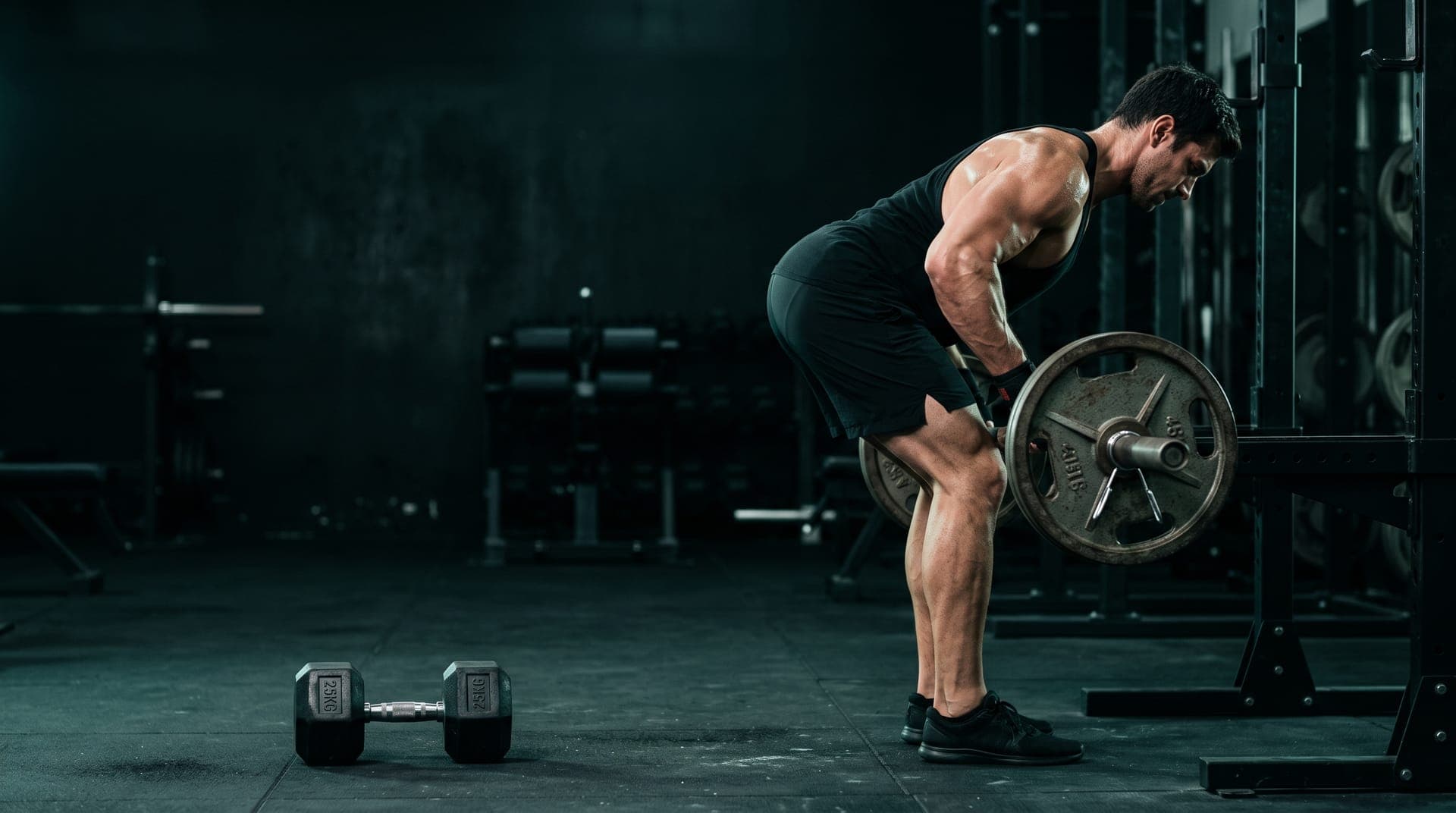
TL;DR: Set for set, compound and isolation exercises grow muscle about equally. Compounds are more efficient because one movement trains several muscles at once. Isolations fill the gaps compounds leave, and those gaps are real: squats barely touch the rectus femoris or hamstrings. Build around compounds, then add targeted isolation work where it matters.
The gym has two camps on this. One says you only need squats, bench, rows, and deadlifts, and that curls are vanity work. The other runs five isolation exercises per body part and treats the barbell as optional.
Both camps are partly right, and the research explains exactly where each one goes wrong.
What the Head-to-Head Studies Show
The cleanest way to test this is to give one group a compound lift and another group an isolation lift for the same muscle, then measure growth.
Gentil et al. (2015) did exactly that with the biceps. Untrained men did either lat pulldowns or dumbbell curls for ten weeks. Elbow flexor thickness increased by a similar amount in both groups. The pulldown group grew their biceps just as much as the curl group, while also training their lats.
The pooled data agrees. A meta-analysis comparing single-joint and multi-joint training across seven studies found no significant difference in hypertrophy between the two. The caveat is that most of these trials compare one exercise against one other exercise, often in beginners, so the estimates are rough. But nothing in the data suggests one category is inherently better at building muscle.
That makes mechanical sense. Muscle grows in response to hard sets taken close to failure with enough load and range of motion. The muscle fiber doesn't know whether the elbow is the only joint moving. What it registers is tension. If you want the deeper version of that idea, our guide on how close to failure you need to train covers it.
Where Compounds Win: Efficiency
If growth per hard set is similar, the next question is how much muscle each set trains. Here compounds pull ahead.
A set of bench press loads the chest, front delts, and triceps. A set of rows hits the lats, upper back, rear delts, and biceps. To match that with isolation work you'd need three or four separate exercises, each with its own warm-up and rest periods.
Paoli et al. (2017) compared multi-joint and single-joint programs at equal total volume over eight weeks. The multi-joint group gained more strength and improved aerobic fitness more, with similar or better body composition changes. For someone training three or four days a week with limited time, that efficiency is a big deal.
It's also why adding isolation work on top of a compound program often does less than people expect. Gentil et al. (2013) had untrained men do lat pulldowns with or without added curls. Adding the curls produced no meaningful extra arm growth. Barbalho et al. (2019) ran a similar design in trained recreational bodybuilders and also found that adding single-joint arm exercises to a multi-joint program didn't significantly increase arm size or strength.
So if you're a beginner who's short on time, the "just do the big lifts" camp has a point. Your arms are getting plenty of stimulus from pressing and pulling.
Where Isolations Win: Coverage
Here's what the compound-only crowd tends to miss. A compound lift doesn't train every muscle it seems to involve equally, and some regions get almost nothing.
The best example is the squat. Kubo et al. (2019) had subjects squat for ten weeks and measured muscle volume with MRI. The vastus muscles and glutes grew. The rectus femoris, one of the four quadriceps heads, didn't grow meaningfully. Neither did the hamstrings. The rectus femoris crosses the hip and knee, so during a squat it shortens at one end while lengthening at the other and never gets much tension.
Knee extensions fix that. Ema et al. (2013) found that knee extension training grew the rectus femoris substantially, more than the other quad heads. A comparison of Smith machine squats and leg extensions in untrained women (Zabaleta-Korta et al., 2021) showed the same split: leg extensions favored rectus femoris growth while squats favored the vastus lateralis.
The triceps show a similar pattern. The long head crosses the shoulder, and Maeo et al. (2023) found overhead triceps extensions, which stretch the long head, produced about 40% more total triceps growth than pushdowns. Bench press doesn't train the long head in that lengthened position at all. Our post on lengthened partials explains why training muscles at long lengths seems to matter so much.
Other common gaps:
- Hamstrings. Squats barely grow them, and hip hinges alone miss the knee-flexion function. Leg curls cover it.
- Side delts. Overhead pressing is mostly front delt. Lateral raises do the work.
- Calves. No compound lift trains them meaningfully.
The Practical Split
The evidence points to a simple structure rather than a camp.
Start with compounds. Pick a press, a pull, a squat or leg press, and a hinge for each training block. These give you the most muscle trained per minute and let you load heavy enough to track real strength progress with something like the one-rep max calculator.
Add isolations to fill specific gaps. Leg extensions and leg curls for complete leg development. Lateral raises for side delts. Overhead triceps work for the long head. Calf raises if you care about your calves.
Count sets honestly. A set of rows counts toward your biceps volume, maybe as half a set, because the biceps work but aren't the limiting muscle. If you're already doing 12 hard sets of pulling per week, adding six sets of curls may push your biceps past what you can recover from. Our breakdown of how many sets per week build muscle gives the ranges.
Let experience shift the ratio. Beginners grow from almost anything, so a compound-heavy program is the efficient choice. Advanced lifters chasing lagging body parts usually need more isolation work, because the compounds stop distributing tension where they want it. For the full picture on structuring this, see our guide to how many exercises per muscle group.
The Bottom Line
Compound versus isolation is the wrong question. Both build muscle at about the same rate per hard set. Compounds give you more total muscle per set and more time back. Isolations reach the parts compounds miss. A good program uses compounds as the base and adds isolation work on purpose, not out of habit.
The tricky part is counting it all. Once you're doing presses, rows, curls, and extensions in the same week, it gets hard to know how much effective volume each muscle is really getting, and whether it's actually growing.
That's what Protokl is built for. It generates your workouts around compound lifts, adds isolation work where your volume is thin, and tracks progression on every exercise. Your body-composition data then shows whether all that work is actually turning into lean mass, so you can see whether the program is working instead of guessing.
References
- Barbalho, M., Coswig, V.S., Raiol, R., et al. (2019). Single joint exercises do not provide benefits in performance and anthropometric changes in recreational bodybuilders. European Journal of Sport Science, 20(1), 72-79.
- Ema, R., Wakahara, T., Miyamoto, N., Kanehisa, H., & Kawakami, Y. (2013). Inhomogeneous architectural changes of the quadriceps femoris induced by resistance training. European Journal of Applied Physiology, 113(11), 2691-2703.
- Gentil, P., Soares, S.R.S., Pereira, M.C., et al. (2013). Effect of adding single-joint exercises to a multi-joint exercise resistance-training program on strength and hypertrophy in untrained subjects. Applied Physiology, Nutrition, and Metabolism, 38(3), 341-344.
- Gentil, P., Soares, S., & Bottaro, M. (2015). Single vs. multi-joint resistance exercises: effects on muscle strength and hypertrophy. Asian Journal of Sports Medicine, 6(2), e24057.
- Kubo, K., Ikebukuro, T., & Yata, H. (2019). Effects of squat training with different depths on lower limb muscle volumes. European Journal of Applied Physiology, 119(9), 1933-1942.
- Maeo, S., Wu, Y., Huang, M., et al. (2023). Triceps brachii hypertrophy is substantially greater after elbow extension training performed in the overhead versus neutral arm position. European Journal of Sport Science, 23(7), 1240-1250.
- Paoli, A., Gentil, P., Moro, T., Marcolin, G., & Bianco, A. (2017). Resistance training with single vs. multi-joint exercises at equal total load volume: effects on body composition, cardiorespiratory fitness, and muscle strength. Frontiers in Physiology, 8, 1105.
- Zabaleta-Korta, A., Fernández-Peña, E., Torres-Unda, J., Garbisu-Hualde, A., & Santos-Concejero, J. (2021). The role of exercise selection in regional muscle hypertrophy: a randomized controlled trial. Journal of Sports Sciences, 39(20), 2298-2304.
Post to Instagram / TikTok
Tap Share, choose Instagram or TikTok, and this 1080×1080 card loads straight into the post composer — ready to publish. Add your caption and point your bio link back here, since links aren’t tappable inside IG/TikTok posts.
Compare Protokl
Related reading
- PHUL vs PHAT: Which One Should You Actually Run?PHUL and PHAT both promise strength and size in the same week. One of them fits into a real life. Here's how the two programs differ, what the volume research says about the gap between them, and how to pick.
- GZCLP Review: The Best Beginner Program Nobody RecommendsGZCLP fixes the two things that break StrongLifts 5x5: not enough volume and no way to fail gracefully. Here's how the three-tier structure works, where it still falls short, and who should run it.
- How Often Should You Change Your Workout Routine?Muscle confusion is not a mechanism. The research says keep your main lifts for months, rotate accessories for anatomical reasons, and change the program when progression stalls instead of when the calendar says so.
Want this as a daily protocol?
Protokl builds personalized workout and nutrition plans around your body composition, goals, and experience level. Science-backed. AI-powered. Syncs with Apple Health.
Get Protokl →