Are Sleep Trackers Accurate? What Your Watch Gets Right and Wrong
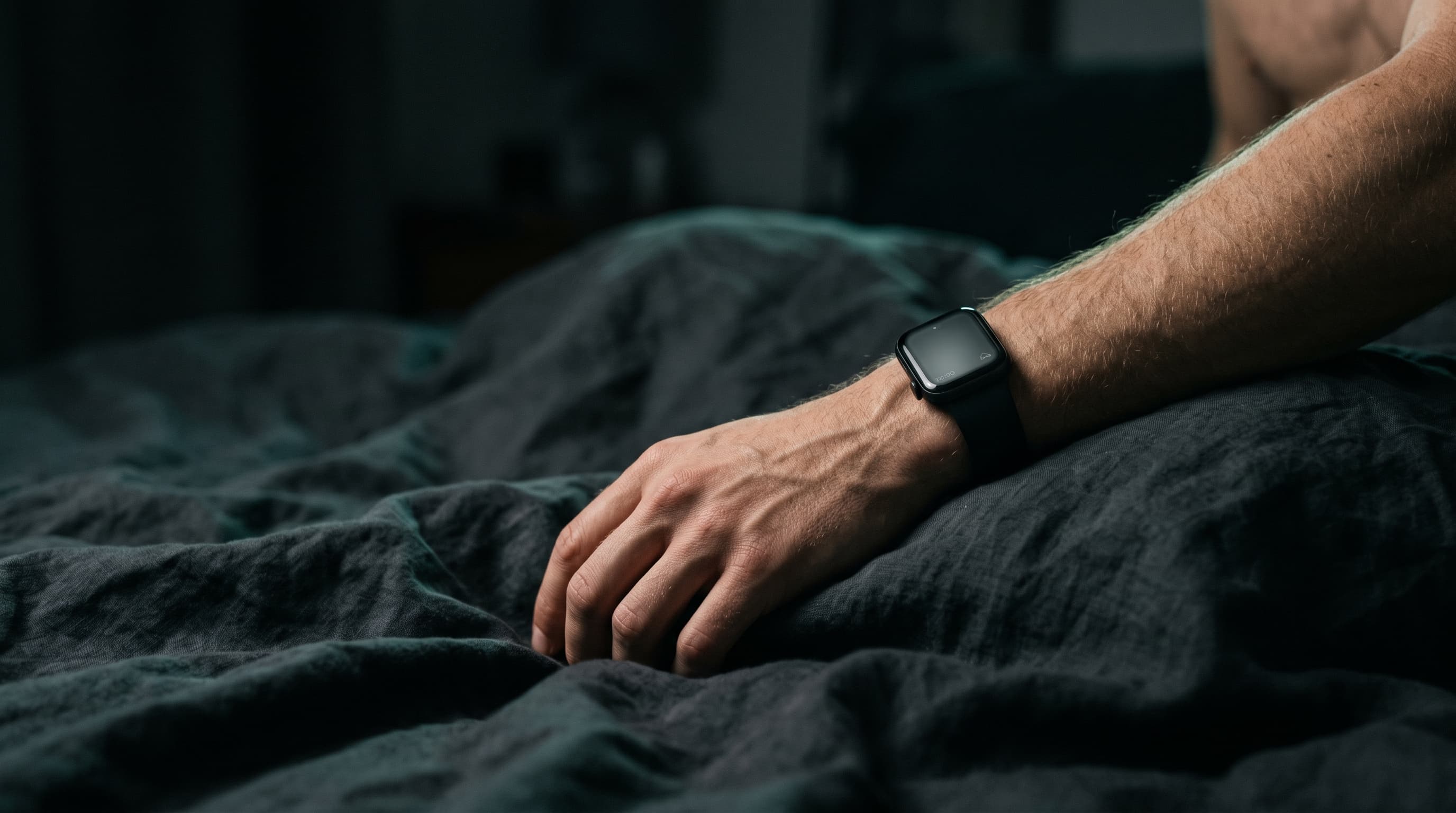
TL;DR: Trust your tracker on how long you slept. Do not trust it on how you slept. Validated against lab polysomnography, consumer wearables estimate total sleep time within about 15 to 40 minutes, which is good enough to act on. Sleep staging is a different story: deep sleep and REM classification is wrong often enough that the colored bar chart in your app is closer to a mood ring than a measurement. Track duration, timing consistency, and the weekly trend. Those are the inputs that move body composition.
Every lifter I know has done the same thing at least once: woken up feeling fine, opened the sleep app, seen 41 minutes of deep sleep, and decided the day was ruined. That reaction is backwards. The one number your watch is reasonably good at is the one people ignore, and the numbers people obsess over are the ones the device is least equipped to produce.
Here's the short version, then the evidence. Duration is usable. Staging is not. Consistency beats both.
What wrist trackers are actually measuring
No consumer wearable measures sleep. It measures movement and heart rate, then runs a classifier that guesses at sleep from those signals. Polysomnography, the lab standard, reads brain activity directly through EEG along with eye movement and muscle tone. That is the gap you are living with. Your watch is inferring brain state from a wrist.
Inferring "asleep versus awake" from stillness and a dropping heart rate is a tractable problem, because sleeping people are mostly still and their heart rates fall. Inferring "N3 deep sleep versus N2 versus REM" from the same two channels is much harder, because those stages differ mostly in electrical activity that never reaches your wrist.
That single distinction predicts basically everything the validation literature found.
The accuracy numbers, honestly
Chinoy and colleagues (2021) put seven consumer sleep trackers head to head with polysomnography in a sleep lab and published the results in SLEEP. The devices performed well at detecting sleep itself, with high sensitivity, and they performed poorly at detecting wake, which is the classic failure mode: lie still in the dark and the algorithm scores you as asleep. Total sleep time estimates were mostly within the range you would call practically acceptable. Stage-level agreement was substantially worse.
More recent work has not rescued the staging. A 2025 validation in SLEEP Advances tested six wrist-worn devices against polysomnography and reported macro F1 scores across sleep stages ranging from about 0.26 to 0.69 depending on the device. The top of that range is respectable. The bottom of it is a coin flip with extra steps. And you generally cannot tell from the app which end your device sits on.
Apple Watch specifically has been validated repeatedly, with total sleep time errors reported anywhere from roughly 12 minutes to about 40 minutes depending on the study population and protocol. Deep sleep is where it struggles most, with detection sensitivity in the 60s as a percentage in several datasets, and a documented tendency to disagree sharply with the lab on how much N3 you got. Apple refreshed its sleep models in late 2025 using data from the Apple Heart and Movement Study, which should help, but it does not change the fundamental signal limitation.
So a fair summary: your watch knows roughly when you fell asleep and when you got up. It is guessing at the middle.
This is the same pattern we found looking at how accurate wearable calorie burn estimates are. The device is a good instrument pointed at a hard problem, and the honest use is directional, not absolute.
Why duration is the number worth having
The reason to care at all is that sleep duration has a direct, measured effect on where your weight comes from during a cut.
Nedeltcheva and colleagues (2010), in the Annals of Internal Medicine, ran a crossover trial in a controlled clinical setting. Ten overweight adults dieted twice, once with 8.5 hours of sleep opportunity and once with 5.5 hours. Total weight lost was the same both times. The composition of that weight was not. On short sleep, the proportion lost as fat fell by 55 percent, and loss of fat-free mass rose by 60 percent. Same deficit, same scale reading, dramatically worse outcome.
Leproult and Van Cauter (2011), publishing in JAMA, restricted healthy young men to five hours in bed for one week and measured a 10 to 15 percent drop in daytime testosterone. Hunger regulation moves in the wrong direction too, with elevated ghrelin and increased appetite reported across the sleep restriction literature.
None of those effects require you to know your REM percentage. They track with hours. That is the whole point: the actionable variable and the reliably measured variable happen to be the same one.
If you want the full mechanistic breakdown, we went deeper on it in sleep, fat loss, and muscle gain.
How to use a tracker you can't fully trust
Four rules, in order of how much they matter.
Read the week, not the night. Single-night estimates carry the most error and the least signal. A seven-night rolling average of total sleep time is a genuinely useful metric. Last Tuesday is noise.
Watch bedtime variance as closely as duration. Consistency of sleep timing is measurable from the same movement data your device already collects reliably, and irregular schedules are independently associated with worse metabolic outcomes. If your midpoint of sleep swings two hours between weekdays and weekends, fix that before you worry about anything else.
Ignore the stage breakdown entirely. Not "weight it lightly." Ignore it. You cannot act on a deep sleep number, you cannot reliably change it on demand, and the measurement is the weakest thing your device produces. Deleting it from your attention costs you nothing.
Use it as an input to training decisions, not a verdict. Two short nights stacked back to back is real information: pull the accessory volume, keep the top sets, delay the PR attempt. That's the same logic behind readiness scoring generally, which we covered in HRV and training readiness, the pillar piece for how we think about recovery data.
One more thing worth saying plainly. If your tracker tells you that you slept badly and you feel fine, believe how you feel. There is a documented phenomenon where wearable feedback itself worsens sleep anxiety and daytime perception. A number derived from wrist accelerometry does not get to overrule your own nervous system.
What this means for a recomp
If you're running a deficit and trying to hold muscle, sleep is not a wellness accessory. It is one of the three or four levers that determine whether the weight you lose is fat or lean tissue, and it sits right next to protein intake and training stimulus in importance. Under-sleeping a cut is close to sabotaging it.
The practical target: seven to nine hours in bed, roughly the same clock time every night, tracked as a weekly average. Bank that and you have done more for your body composition than any supplement decision you will make this year.
Protokl reads sleep from Apple Health and folds duration and consistency into daily readiness and recovery scoring, which then feeds the training recommendation you actually see. It uses the part of the signal that holds up and does not pretend the stage breakdown means more than it does. If you want to see how sleep, deficit size, and training volume interact on your own numbers over the next few months, the physique forecast tool will show you the shape of it before you commit to a plan.
Post to Instagram / TikTok
Tap Share, choose Instagram or TikTok, and this 1080×1080 card loads straight into the post composer — ready to publish. Add your caption and point your bio link back here, since links aren’t tappable inside IG/TikTok posts.
Related reading
- HRV and Training Readiness: How to Know When to Push or Back OffYour morning HRV reading is the closest thing to a fuel gauge for training. Here's what it actually measures, how to read it without obsessing, and how to turn it into a real push-or-rest decision.
- What Is Lean Body Mass? (And How to Calculate It Correctly)Lean body mass is the body-composition number that actually predicts training outcomes. Here is what it is, how to estimate it, and how to use it to set protein and calories.
- How Sleep Affects Fat Loss and Muscle GainSleep is a primary body-composition variable, not a recovery afterthought. The research on how short sleep wrecks fat loss, spikes hunger, lowers testosterone, and costs you muscle, plus what to actually do.
Want this as a daily protocol?
Protokl builds personalized workout and nutrition plans around your body composition, goals, and experience level. Science-backed. AI-powered. Syncs with Apple Health.
Get Protokl →