How Accurate Is Your Apple Watch's Calorie Burn? (What the Research Says)
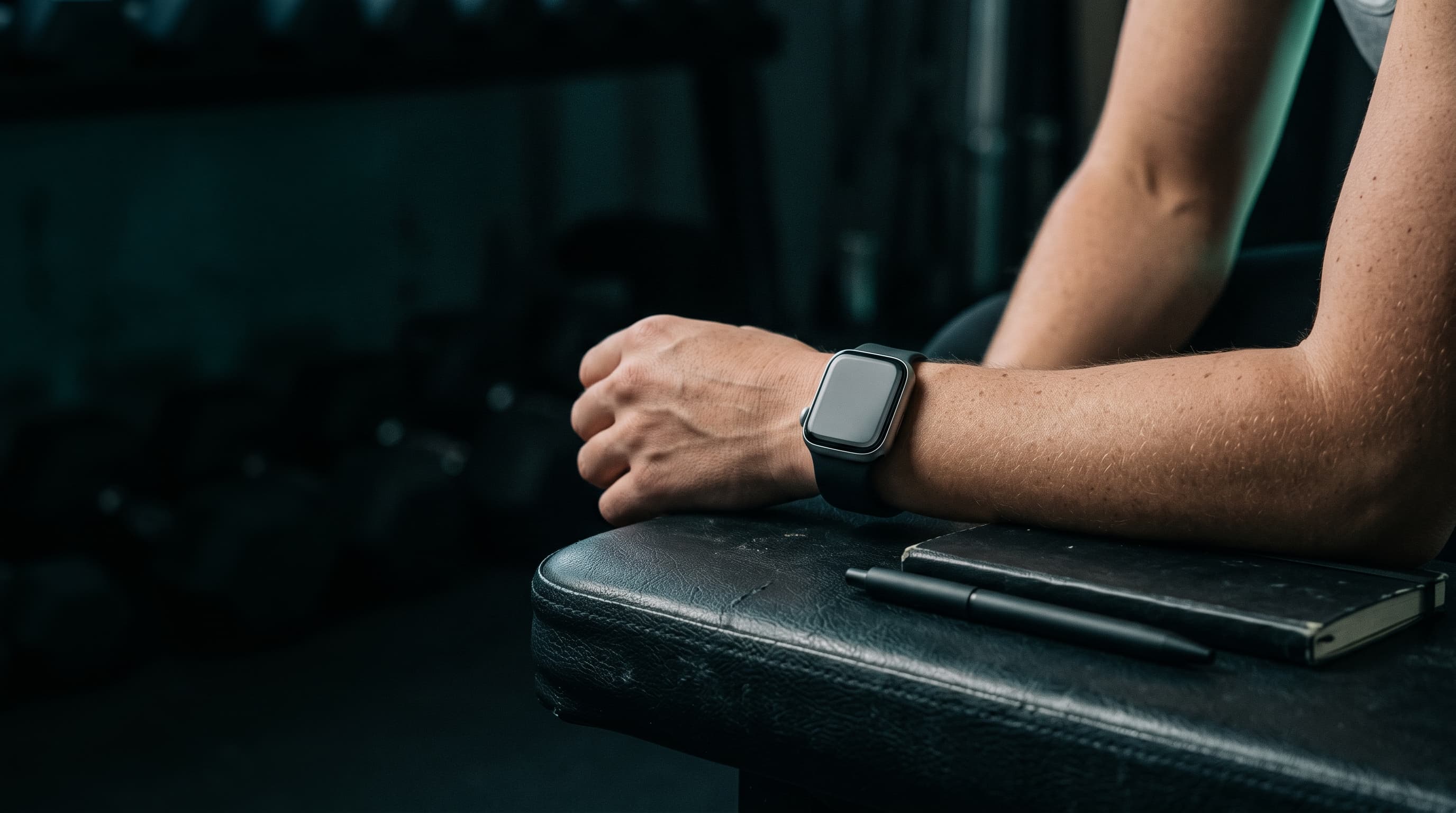
TL;DR: Your Apple Watch is excellent at heart rate and terrible at calories. Controlled studies put its energy-expenditure error near 40 percent, so stop using the active-calorie number to size your deficit and let your actual weight trend do that job instead.
The short answer
Your Apple Watch closes the red ring with a number that is confidently wrong. In the most-cited independent test, Stanford researchers measured energy-expenditure error near 40 percent for the Apple Watch, even though the same device tracked heart rate within a few beats per minute (Shcherbina et al., 2017). Heart rate is a sensor reading. Calorie burn is a guess built on top of that reading, and the guess is bad.
That gap matters because millions of people size their diet around the active-calories number. They "earn back" 500 calories from a workout the watch overcounted, eat those calories, and then wonder why the scale will not move. If you are cutting or running a recomposition, treating that number as truth is one of the fastest ways to stall.
Why heart rate is good and calories are not
The optical sensor on the back of the watch measures blood flow through your wrist and converts it to a heart rate. That is a direct physical measurement, and it is accurate for steady-state cardio like running and cycling. This is the part Apple genuinely nailed.
Calorie burn is a different animal. No wrist device measures the energy you spend. It infers it from heart rate, movement, and the profile you entered (age, weight, height, sex), then runs that through a proprietary model. Every one of those inputs carries error, and the model has to generalize across bodies it has never seen. Two people with the same heart rate during the same walk can burn meaningfully different amounts depending on muscle mass, fitness, and mechanical efficiency, and the watch has no way to know that.
The research is blunt about the result. A large systematic review of commercial wearables found that no brand stayed within an acceptable error band for energy expenditure, and none came within 3 percent of true burn more than a small fraction of the time (Fuller et al., 2020). Heart rate and step counting held up well across the same devices. Calories did not.
The error is not random, and it is not small
If the watch were simply noisy, the overcounts and undercounts would wash out over weeks. They do not, because the error is biased and it tracks specific traits.
In the Stanford data, accuracy got worse with higher body weight and higher BMI, and it differed by sex (Shcherbina et al., 2017). More recent work has flagged skin tone and body-fat percentage as additional sources of drift in wrist-based calorie estimates, since optical sensors read differently across skin and tissue. The practical takeaway: the person who most wants a reliable calorie number, someone carrying extra fat and trying to lose it, is often the person the watch reads least accurately. Low-intensity activity is also where it struggles most, and low-intensity activity is most of your day.
So the number is not a fuzzy-but-centered estimate. For a lot of users it is a consistent overcount, in the one direction that quietly sabotages a fat-loss phase.
What to actually track instead
Here is the reframe that fixes this. You do not need to know your calorie burn. You need to know your energy balance, and your body already reports that for free, every morning, on the scale.
Your weight trend over two to three weeks is the only "calorie tracker" that accounts for your real metabolism, your real activity, and your real adherence at the same time. If your weekly average weight is dropping, you are in a deficit, full stop. If it is flat for two to three weeks, you are at maintenance no matter what any ring says. This is the logic behind an adaptive approach to calories: instead of trusting a device or a formula up front, you set an intake, watch the trend, and adjust. We break the mechanics down in adaptive TDEE vs static calorie calculators, and the same principle is why a static estimate of your maintenance calories is only ever a starting guess.
A concrete protocol:
- Anchor on intake, not output. Set your calories from a starting estimate, then let two to three weeks of weight-trend data tell you if it was right. Adjust in 100 to 200 calorie steps.
- Weigh most days and read the average. Daily weight is noisy from water, sodium, and glycogen. The seven-day average is the signal. This is also why the scale jumping 3 pounds overnight means nothing on its own, which we cover in why the scale lies about water weight.
- Use the watch for what it is good at. Heart rate zones, resting heart rate trends, and workout intensity are all legitimately useful, and they are the features worth your attention, as we lay out in Apple Watch fitness features that actually matter. If you want to train by zones, size them properly with a heart rate zone calculator.
Notice what drops out of that list: eating back "earned" calories. Once your intake is anchored and validated against the trend, the active-calories number has no job left to do.
But the watch keeps me consistent
Fair, and worth keeping. Move rings and streaks are good behavior tools. Closing them gets people off the couch, and that is real value. The mistake is not wearing the watch. The mistake is doing arithmetic with a number that carries 40 percent error and then eating the result.
Use the ring as a nudge to move. Use your weight trend to run your diet. Those two jobs do not conflict, and keeping them separate is the whole fix.
The bottom line
Apple Watch calorie burn is not a small measurement error you can average away. It is a biased estimate, wrong by roughly 40 percent in controlled testing, and wrong in the direction that stalls fat loss for the people who most need it accurate. The sensor data your watch collects is genuinely good. The calorie number layered on top is the weakest thing it does.
This is exactly why Protokl does not ask you to trust a device's burn estimate or a one-time formula. It watches your actual weight and body-composition trend and adapts your targets to what your body is really doing, so a recomposition or a cut is driven by the ground truth instead of a wrist guess. If you are tired of the ring telling you one thing while the scale tells you another, see how Protokl forecasts your body composition from your real data.
References: Shcherbina, A., et al. (2017). Accuracy in Wrist-Worn, Sensor-Based Measurements of Heart Rate and Energy Expenditure in a Diverse Cohort. Journal of Personalized Medicine, 7(2), 3. Fuller, D., et al. (2020). Reliability and Validity of Commercially Available Wearable Devices for Measuring Steps, Energy Expenditure, and Heart Rate: Systematic Review. JMIR mHealth and uHealth, 8(9), e18694.
Post to Instagram / TikTok
Tap Share, choose Instagram or TikTok, and this 1080×1080 card loads straight into the post composer — ready to publish. Add your caption and point your bio link back here, since links aren’t tappable inside IG/TikTok posts.
Related reading
- How to Break a Weight Loss PlateauStuck at the same weight for weeks? Most plateaus aren't metabolic. Here's how to diagnose the real cause in order, and what to do when adaptation is genuine.
- HRV and Training Readiness: How to Know When to Push or Back OffYour morning HRV reading is the closest thing to a fuel gauge for training. Here's what it actually measures, how to read it without obsessing, and how to turn it into a real push-or-rest decision.
- Why the 3,500-Calorie Rule Overpredicts Your Fat LossA 500-calorie deficit is supposed to give you a pound a week. It doesn't, and the gap gets worse the longer you diet. Here's the math behind why linear deficit projections fail and what to plan around instead.
Want this as a daily protocol?
Protokl builds personalized workout and nutrition plans around your body composition, goals, and experience level. Science-backed. AI-powered. Syncs with Apple Health.
Get Protokl →