Is Apple Watch Heart Rate Accurate When Lifting Weights?
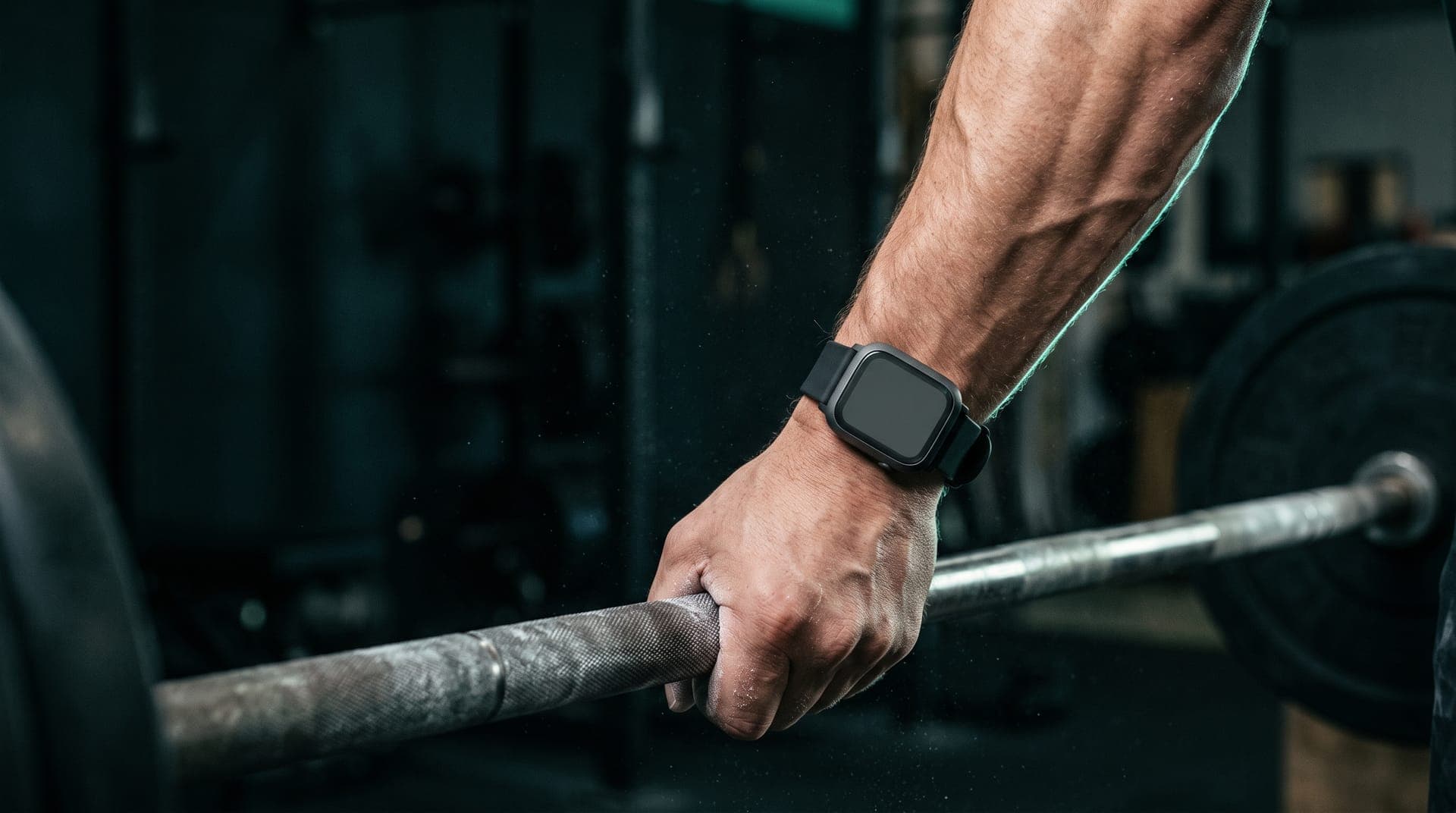
TL;DR: Apple Watch heart rate is surprisingly good during strength training, and in head-to-head tests it beats most other wrist devices. On squats, deadlifts, and rows it tracks a chest strap closely. On grip-heavy, wrist-bending, or explosive movements (curls to press, burpees, heavy carries) the error grows. Wear it snug, slide it a finger above the wrist bone, or pair a Bluetooth chest strap. And don't use heart rate to judge how hard a set was. That's what reps in reserve are for.
If you've ever glanced at your watch mid-set and seen 92 bpm while your quads were on fire, you've already noticed the problem. Wrist heart rate was built for steady movement. Lifting is the opposite: short, violent efforts, a death grip on a bar, and a wrist that bends and locks under load.
So how much should you trust the number? More than you'd think on some lifts, and a lot less on others.
How the watch reads your pulse
Apple Watch uses photoplethysmography (PPG). Green LEDs flash into your skin and photodiodes measure how much light comes back. Every heartbeat pushes a small wave of blood through the capillaries in your wrist, which changes how much light gets absorbed. The watch counts those waves.
That works beautifully when the only thing moving blood around under the sensor is your heart. During a run, your arm swings rhythmically and the algorithm can filter that motion out. During a heavy set, three things go wrong at once:
- Gripping. Squeezing a bar tightens the forearm muscles and tendons right under the sensor, which changes local blood flow and how the watch sits on your skin.
- Wrist flexion. Curls, presses, front squats, and push-ups bend the wrist, so the case shifts and lets ambient light leak in.
- Fast swings in heart rate. Bracing and breath-holding (the Valsalva maneuver) can make heart rate spike and drop within seconds. Wrist devices smooth their readings, so they lag behind those quick changes.
Bent and colleagues tested several wrist devices and found error rose by roughly 30% during activity compared with rest, with motion as the main culprit (Bent et al., 2020). Lifting is just about the worst-case motion profile for an optical sensor.
What the studies actually show
The good news for Apple Watch owners is that it tends to come out on top.
A 2023 study in the Journal of Sports Sciences had 29 lifters do back squats, deadlifts, dumbbell curl to overhead press, seated cable rows, and burpees at several intensities while wearing an Apple Watch Series 6, a Whoop 3.0, and a Polar H10 chest strap as the reference. The Apple Watch agreed closely with the chest strap on squats, deadlifts, and rows (correlations above 0.83). On the curl-to-press and burpees, agreement fell to moderate or low. Whoop was less consistent across the board. The authors concluded Apple Watch was good enough for monitoring resistance training, with the caveat that it depends on the exercise.
A separate validation study put 62 healthy men through standardized endurance and resistance sessions wearing Apple, Samsung Galaxy, Fitbit, and Garmin watches, with ECG as the gold standard. Every watch was fine during endurance work. During resistance exercise, Apple Watch was the only one with no significant difference from ECG.
Older research is less flattering for the category as a whole. Boudreaux and colleagues found wrist heart rate accuracy declined during resistance exercise compared with cycling at matched effort, with the biggest errors at higher intensities (Boudreaux et al., 2018). And in Gillinov's treadmill, bike, and elliptical comparison, the chest strap beat every wrist device, though Apple Watch was the best of the wrist group (Gillinov et al., 2017).
Put together: Apple Watch is about as good as wrist heart rate gets, it's solid on stable compound lifts, and it gets noisy whenever your wrist is working hard.
Which lifts it handles well (and which it doesn't)
Based on the study patterns above and how PPG fails:
Usually reliable
- Back squats and leg press (hands on the bar or handles, but the wrist stays fairly neutral)
- Deadlifts and RDLs (heavy grip, but a straight, stable wrist)
- Seated cable and machine rows
- Most leg machines and steady cardio finishers
Often unreliable
- Curls, especially when they flow into a press
- Push-ups, front squats, and anything that cranks the wrist back
- Burpees, kettlebell swings, and other fast, explosive circuits
- Farmer's carries and heavy shrugs, where the forearm is maxed out the whole time
If your watch reads oddly low in the middle of a hard set and then jumps 30 beats when you rack the weight, that's usually the sensor catching up, not your heart doing something strange.
How to get cleaner heart rate data in the gym
You can fix most of the problem in about ten seconds.
- Tighten the band for the workout. Snug enough that the sensor doesn't move when you twist your wrist. Loosen it afterward. A sport loop makes this easy.
- Move it up your arm. Slide the watch a finger's width above the wrist bone. You get less tendon movement and less light leakage when the wrist bends.
- Pair a chest strap. Apple Watch accepts Bluetooth heart rate monitors, and a strap like the Polar H10 reads electrical signals from the heart itself. If you care about heart rate during lifting (conditioning circuits, cardiac rehab, or just clean data), this is the real answer.
- Start the right workout type. Use Traditional or Functional Strength Training so the algorithm expects the movement pattern.
- Clean the sensor. Sweat, chalk, and lotion all degrade the optical signal.
Should you even care about heart rate when lifting?
For most lifters, not much. Heart rate is a decent marker of cardiovascular strain, but it's a poor marker of how hard a set was for your muscles. A set of five heavy deadlifts and a set of fifteen leg extensions can end at similar heart rates while delivering completely different stimulus.
Effort in the weight room is better measured by how close you got to failure. That's why we lean on reps in reserve; here's how to calibrate yours. Rest times work the same way. Waiting for your heart rate to drop below some number is less useful than resting long enough to perform the next set well.
Where heart rate does matter is the bigger picture: resting heart rate and HRV trends over weeks, which tell you a lot about recovery. That's covered in our guide to HRV and training readiness. And if you're relying on the watch's calorie number after a lifting session, know that it inherits all the heart rate error above and then adds its own. We break that down in how accurate Apple Watch calorie burn really is. If you want a sense of zones for your cardio days, the heart rate zone calculator will get you close.
The bottom line
Apple Watch is the best wrist heart rate monitor you're likely to own for lifting, and on stable compound movements it's genuinely accurate. On grip-heavy, wrist-bending, or explosive work, treat the number as a rough sketch. Tighten the band, move it up the arm, or pair a chest strap if you need precision.
Then put the data where it's useful. Protokl pulls your Apple Health heart rate, HRV, sleep, and workouts into the same place as your training log and nutrition, so a noisy reading from one set doesn't drive a bad decision, and the trends that actually predict progress get read in context. Your watch is already collecting the data. It might as well feed a plan.
Post to Instagram / TikTok
Tap Share, choose Instagram or TikTok, and this 1080×1080 card loads straight into the post composer — ready to publish. Add your caption and point your bio link back here, since links aren’t tappable inside IG/TikTok posts.
Related reading
- HRV and Training Readiness: How to Know When to Push or Back OffYour morning HRV reading is the closest thing to a fuel gauge for training. Here's what it actually measures, how to read it without obsessing, and how to turn it into a real push-or-rest decision.
- Fitbod vs Hevy vs Strong: Best Workout Tracker in 2026Comparing Fitbod's AI programming, Hevy's social features, and Strong's minimalist logging to find the best workout tracker -- and what all three are missing.
- How Accurate Is Apple Watch VO2 Max? What the Validation Studies ShowThree lab studies have now tested Apple Watch's Cardio Fitness number against a metabolic cart. It reads about 13 to 16% off for an individual, and it's biased in a predictable direction. Here's how to use it anyway.
Want this as a daily protocol?
Protokl builds personalized workout and nutrition plans around your body composition, goals, and experience level. Science-backed. AI-powered. Syncs with Apple Health.
Get Protokl →