Should You Eat Back Exercise Calories? The Honest Answer
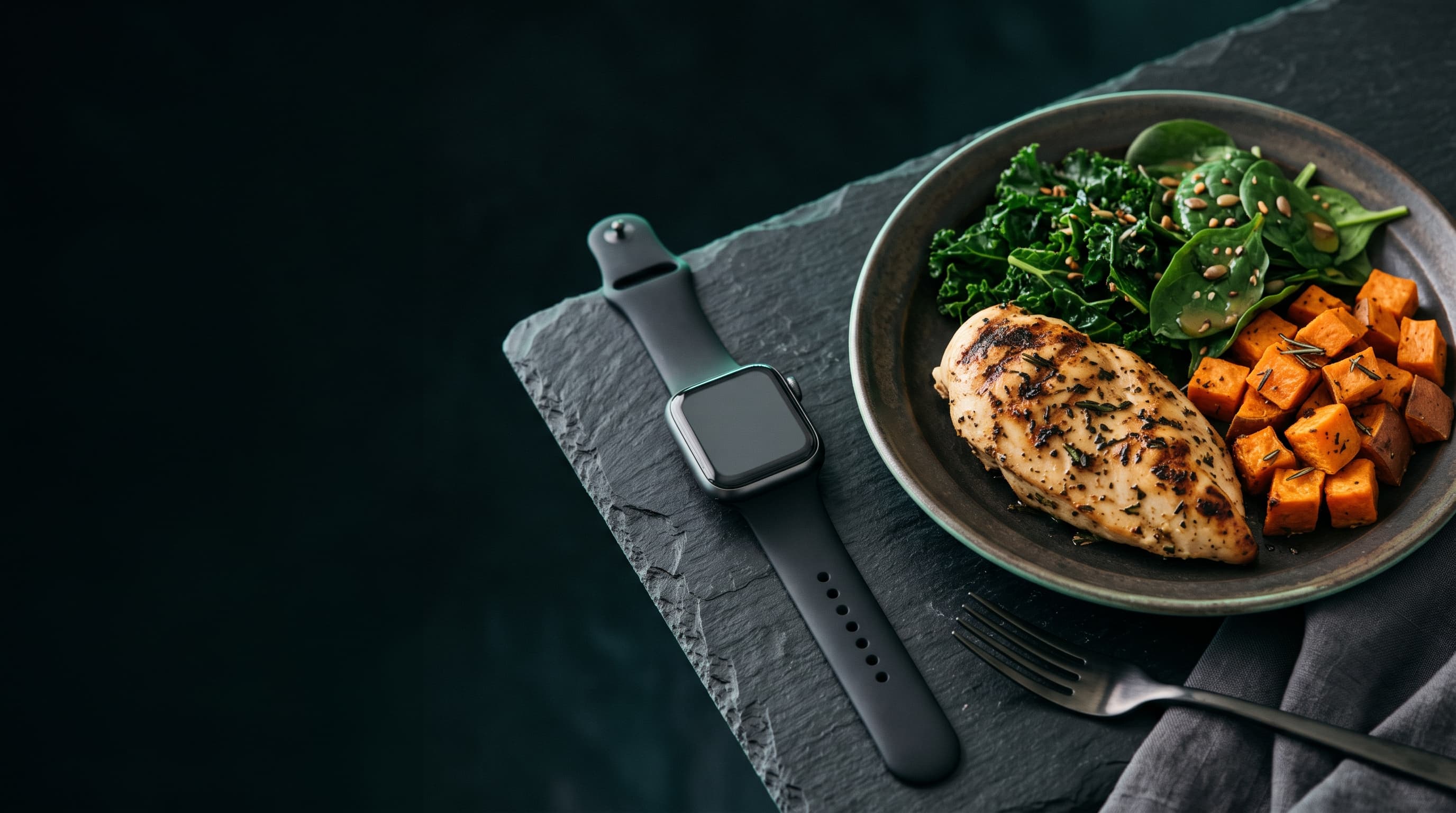
TL;DR: The right answer isn't a number, it's a question about your target. If your calorie goal was set from a TDEE that already assumed you train, then logging a workout and eating those calories back is counting the same energy twice, and it's the single most common reason a "perfect" deficit produces no fat loss. If your goal is a flat sedentary baseline, you can eat some exercise back, but treat your watch's number as a rumor: trackers overestimate burn by 27 to 93 percent, so eat back roughly half at most. Better still, stop keeping two ledgers and use a target that adjusts to your actual weight trend.
You finish a hard session, your watch flashes 620 calories burned, and the app cheerfully adds them to your daily budget. Dinner just got bigger. It feels like a reward you earned. For a lot of people, it's also the exact moment their diet stops working.
Eating back exercise calories is one of those questions that sounds simple and hides a real trap. The honest answer isn't yes or no. It's: it depends on how your target was built, and on how much you trust the number on your wrist. Let's take both apart.
The double-counting problem
Here's the mistake almost nobody notices they're making.
When you set up most calorie targets, you pick an activity level. "Lightly active," "moderately active," "very active." That multiplier bakes an estimate of your exercise straight into the number. A moderately active setting already assumes you're training several times a week and pads your daily calories accordingly.
So if your target came from a "moderately active" calculation, your workouts are already in the number. Log a session, let the app hand you 600 more calories, and eat them, and you've now counted that same workout twice. Your "500-calorie deficit" quietly becomes a wash. The scale doesn't move, you can't figure out why, and the tracking feels like a lie.
This is why the standard advice from most coaches is blunt: if your target already accounts for activity, don't eat exercise calories back at all. The exercise is priced in.
The only time eating some back is defensible is when your target was built on a true sedentary baseline, a number that assumes you do nothing but exist and then adds movement separately. That's how apps like the old MyFitnessPal model worked, and it's why they surface exercise calories as a bonus. If that's your setup, exercise genuinely isn't in the base number yet, so adding some back is at least logically consistent. For the full picture of why static multipliers drift from reality, see adaptive TDEE vs static calorie calculators.
Even then, don't trust the number
Say you're on a sedentary baseline and the double-counting problem doesn't apply. You still shouldn't eat back the full burn, because the burn figure is one of the least reliable numbers your devices produce.
The landmark evidence here is a Stanford study that tested seven popular wrist wearables, including the Apple Watch, on 60 people across a range of activities (Shcherbina et al., 2017). The finding was a split verdict. Heart rate was excellent: six of seven devices landed within 5 percent. Energy expenditure was a disaster: the most accurate device had a median error of 27 percent, and the worst was off by 93 percent. Not one device measured calorie burn well.
And the errors don't cancel out. Across the literature, trackers lean toward overestimating burn, not underestimating it. So the 620 on your watch might really be 400, or 320. If you eat back the whole 620, you've handed yourself a few hundred phantom calories. Do that a few times a week and a deficit turns into maintenance without you ever "cheating." I went deeper on this in how accurate is Apple Watch calorie burn, and the short version is: it's fine as a consistency signal, useless as an accounting figure.
There's a behavioral layer too. People tend to eat a little more after training without logging it, and to move a little less the rest of the day, an effect researchers call compensation. So the real recoverable deficit from a workout is smaller than the raw number twice over: once for tracker error, once for unconscious compensation.
Put those together and the practical rule, if you're going to eat any back, is eat back about half of what the device claims, and only from a sedentary baseline. Half is a rough correction for overestimation, and it leaves room for the compensation you're not tracking.
The cleaner answer: stop keeping two ledgers
Step back and notice what this whole debate really is. It's an attempt to reconcile two guesses: a guessed maintenance number and a guessed exercise burn, hoping the errors don't compound. That's a fragile way to run a diet.
The variable that actually tells the truth is your body. Your weight trend over two to three weeks is the real integral of everything, food logged and unlogged, exercise burned and overestimated, NEAT, water, all of it. If you're eating in a genuine deficit, the trend line falls. If it's flat, you're at maintenance no matter what any calculator or watch insists.
That's the logic behind an adaptive target. Instead of asking "how many calories did I burn today," it asks "given what you ate and how your weight actually moved, what is your real maintenance right now," and it nudges your number accordingly. The exercise-calorie question dissolves, because you never keep a separate exercise ledger to double-count in the first place. Your workouts show up automatically, correctly, in how your weight responds. This is the same principle that makes a good cut protocol self-correct instead of relying on a spreadsheet you set once and never revisit.
So, practically, what do you do?
- If your target assumes activity (moderately or very active): don't eat exercise calories back. They're already in the number. This covers most people using a standard TDEE calculator.
- If your target is a true sedentary baseline: you can eat back roughly half your estimated burn, never the full amount. Treat the watch figure as inflated by default.
- Either way: anchor to your two-to-three-week weight trend, not to any single day's math. If the trend isn't moving the way you want, adjust intake, not the exercise accounting.
- Want to skip the argument entirely: use a target that adapts to your data. If you want a clean starting number to adapt from, run your intake through the macro calculator and let the trend refine it from there.
The reason this question causes so much frustration is that it's usually the wrong question. "How many calories did I earn back" assumes precision that neither your calculator nor your wearable actually has. The number on your wrist is a motivational readout, not an accounting entry. Feed the deficit from your intake, verify it against the scale trend, and let the exercise take care of itself.
That's exactly how Protokl handles it. Rather than making you referee two competing estimates every day, it learns your real maintenance from your weight and intake data and moves your target with you, so a hard training week doesn't turn into a math problem you have to solve at dinner. If you're tired of watching a "perfect" deficit go nowhere, that's the part worth fixing.
Post to Instagram / TikTok
Tap Share, choose Instagram or TikTok, and this 1080×1080 card loads straight into the post composer — ready to publish. Add your caption and point your bio link back here, since links aren’t tappable inside IG/TikTok posts.
Related reading
- How to Manage Hunger on a Cut Without Eating More CaloriesHunger is the reason most cuts fail, and it's more controllable than people think. Here's what actually moves appetite at a fixed calorie target: protein dose, food volume, processing level, and sleep.
- How to Break a Weight Loss PlateauStuck at the same weight for weeks? Most plateaus aren't metabolic. Here's how to diagnose the real cause in order, and what to do when adaptation is genuine.
- How to Track Calories When You Eat Out (Without Guessing)Restaurant meals are where most tracking falls apart. Here's what the research says about menu accuracy, how far off your own estimates are, and a practical system for logging food you didn't cook.
Want this as a daily protocol?
Protokl builds personalized workout and nutrition plans around your body composition, goals, and experience level. Science-backed. AI-powered. Syncs with Apple Health.
Get Protokl →