Plant Protein vs Whey: Does the Source Actually Matter for Muscle?
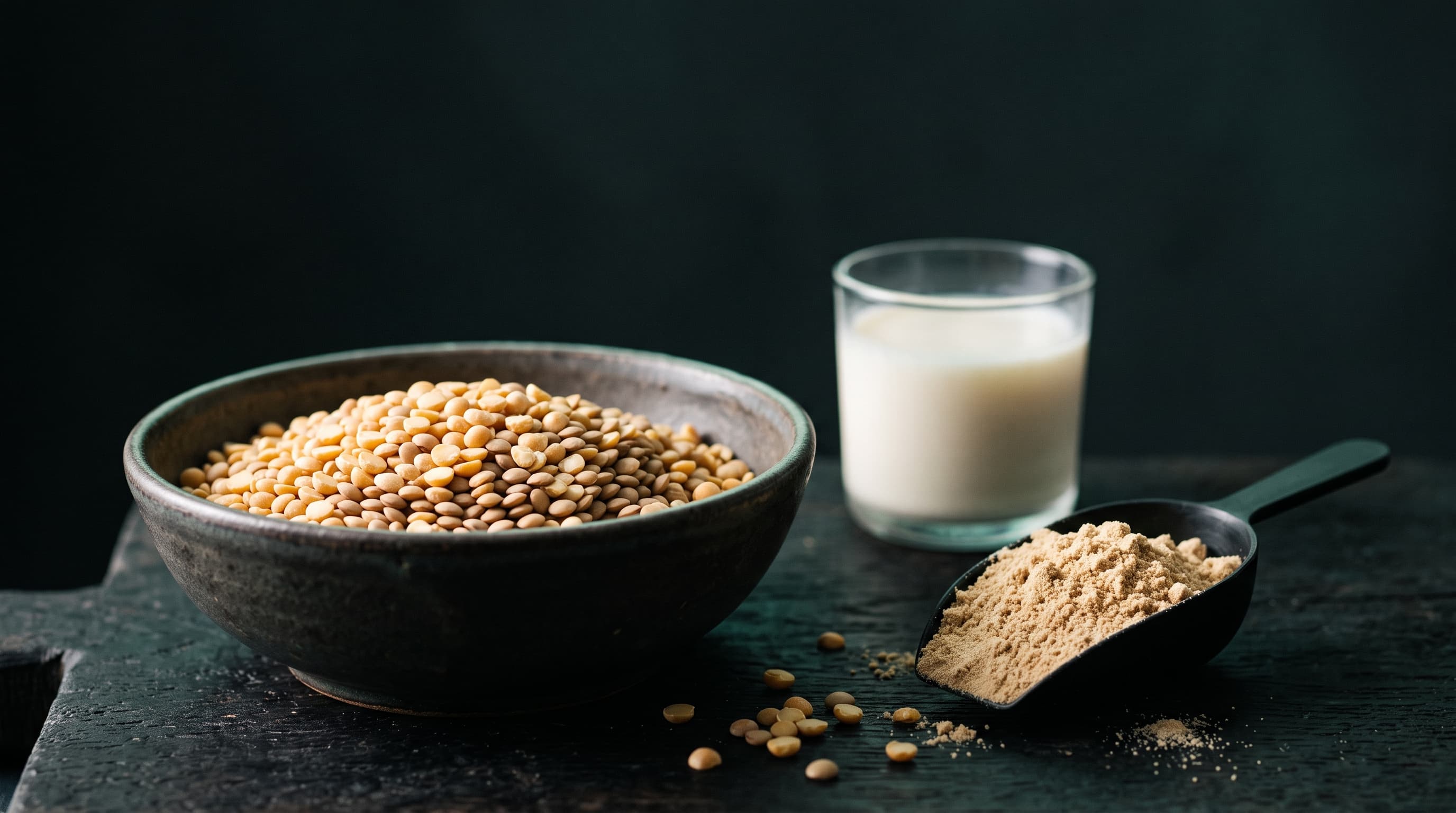
TL;DR: On paper whey wins. In practice, when you match total daily protein and leucine content, plant protein produces the same muscle growth and strength gains in training studies. The real disadvantage isn't that plants are "inferior protein," it's that a scoop of pea or rice protein carries less leucine and fewer essential amino acids than a scoop of whey. Size the dose up by roughly 25 to 30 percent, use a blend instead of a single plant source, and hit 1.6 to 2.2g per kilogram of bodyweight a day. Do that and your protein source becomes a preference, not a performance variable.
Every few months someone posts a chart of amino acid profiles and declares plant protein a waste of money. The chart isn't wrong. Whey really does have a better profile: more leucine per gram, a complete set of essential amino acids, and faster digestion. If protein quality scores were the whole story, the argument would be over.
But quality scores measure a single scoop in a lab. They don't measure what happens to a lifter eating 180g of protein a day for three months. And when researchers run that experiment, the tidy paper advantage mostly evaporates.
What the head-to-head studies found
The cleanest test of this question came out of Brazil. Hevia-Larraín and colleagues (2021, Sports Medicine) took young men who were habitually vegan and men who were habitually omnivorous, put both groups on a 12-week leg training program, and matched protein intake at 1.6g per kilogram of bodyweight. The vegans hit that number with soy supplementation. The omnivores used whey and animal foods.
After 12 weeks the groups were indistinguishable. Muscle cross-sectional area, leg press strength, lean mass: no meaningful difference on any measure. Same program, same protein, same result.
That finding lines up with the acute work. Monteyne and colleagues (2023, American Journal of Physiology: Endocrinology and Metabolism) fed resistance-trained subjects mycoprotein, pea protein, or a blend of the two after a workout and measured myofibrillar protein synthesis directly. All three produced comparable rates. Pinckaers and colleagues (2024) ran a similar design with a wheat, corn and pea blend against whey in trained adults and found equivalent post-exercise protein synthesis, despite the plant blend having a different essential amino acid profile on paper.
Three different research groups, three different plant sources, same conclusion. Once you get enough of it in, the muscle doesn't care where the amino acids came from.
Where the actual gap is
So why does the amino acid chart still matter? Because "getting enough of it in" is where plant sources genuinely fall behind, and pretending otherwise sets people up to underdose.
Two real gaps:
Leucine density. Leucine is the amino acid that flips the switch on muscle protein synthesis, and you need roughly 2 to 3g in a serving to hit that threshold reliably. Whey is about 10 to 11 percent leucine, so 25g of whey clears it easily. Pea protein sits closer to 8 percent and rice protein lower still, so the same 25g scoop can land under the line. A 2024 study in Current Developments in Nutrition tested exactly this: plant isolate on its own produced a smaller protein synthesis response than whey, but plant isolate with added leucine matched whey completely. The gap was the leucine, not the plant.
Incomplete profiles. Most single plant sources are short on one essential amino acid. Legumes run low on methionine. Grains run low on lysine. Neither is a problem across a varied day of eating, and it stops being a problem in a single serving the moment you blend sources, which is why the research keeps testing blends rather than isolated pea or rice.
Both gaps have the same fix, and it's not switching to whey.
How to close the gap
Three adjustments, in order of how much they matter.
Eat more of it. If you're building your protein intake mainly from plants, aim toward the top of the range rather than the bottom. Instead of 1.6g per kilogram, target closer to 2.0 to 2.2g. That single change compensates for lower leucine density without any amino acid arithmetic. My full breakdown of the daily target is in how much protein you actually need per day, and the protein calculator will set the number for you.
Use blends, not single sources. A pea and rice blend covers what either one lacks alone. Soy is already complete and holds up well in training studies. Mycoprotein performs about as well as anything tested. If your powder lists one plant protein and nothing else, that's the one to upgrade.
Push per-serving doses a little higher. Where 25g of whey does the job, 30 to 35g of a plant blend gets you to the same leucine. This is the same logic behind why the 30g-per-meal cap is a myth: larger doses get absorbed and used, so rounding up costs you nothing but a few calories.
Timing, by the way, is not on this list. Whey digests faster than most plant proteins, which sounds like it should matter, but protein timing moves the needle far less than people assume once the daily total is handled.
The part nobody mentions
There's a context where the source question gets less academic: cutting. In a deficit, protein is doing double duty as the thing that keeps your muscle from being burned for fuel, and the margin for error narrows. If you're eating 1.6g/kg of exclusively plant protein while running a 500-calorie deficit and training hard, that's the scenario where a leucine shortfall could plausibly cost you tissue. The fix is the same, just less optional: push the total up and use blends. I lay out the rest of the muscle-preservation stack in how to build a cut protocol.
On a lean bulk the stakes are lower. You've got surplus energy, and a slightly suboptimal amino acid profile gets buried under everything else going right.
What to actually do
- Pick the protein you'll eat consistently. Adherence beats amino acid scores over any timeframe that matters.
- If you're plant-based, target 2.0 to 2.2g per kilogram. Treat the higher number as the price of admission, not as excess.
- Choose blends or soy over single-source pea or rice. Or just add a leucine supplement to what you already have.
- Round your servings up. 30 to 35g per shake instead of 25g.
- Track the daily total, not the source. That's the variable the studies keep confirming.
The amino acid chart makes plant protein look like a compromise. Twelve weeks of matched training says it isn't. The only thing you're actually compromising on is scoop size.
Protokl tracks your protein against a target that adapts to your bodyweight, training load and goal, so you can see whether you're actually clearing the number rather than assuming your shake covered it. That matters more when your protein comes from sources that need a bigger dose to do the same job. See how Protokl handles your macros.
Sources: Hevia-Larraín et al., 2021, Sports Medicine; Monteyne et al., 2023, American Journal of Physiology: Endocrinology and Metabolism; Pinckaers et al., 2024, The Journal of Nutrition; Current Developments in Nutrition, 2024 (plant isolates with and without added leucine vs whey).
Post to Instagram / TikTok
Tap Share, choose Instagram or TikTok, and this 1080×1080 card loads straight into the post composer — ready to publish. Add your caption and point your bio link back here, since links aren’t tappable inside IG/TikTok posts.
Compare Protokl
Related reading
- How to Manage Hunger on a Cut Without Eating More CaloriesHunger is the reason most cuts fail, and it's more controllable than people think. Here's what actually moves appetite at a fixed calorie target: protein dose, food volume, processing level, and sleep.
- GZCLP Review: The Best Beginner Program Nobody RecommendsGZCLP fixes the two things that break StrongLifts 5x5: not enough volume and no way to fail gracefully. Here's how the three-tier structure works, where it still falls short, and who should run it.
- Should You Eat Protein Before Bed? What the Casein Research Actually ShowsA pre-sleep protein shake does raise overnight muscle building. But when total daily protein is matched, bedtime protein beats daytime protein by roughly nothing. Here's how to use it.
Want this as a daily protocol?
Protokl builds personalized workout and nutrition plans around your body composition, goals, and experience level. Science-backed. AI-powered. Syncs with Apple Health.
Get Protokl →