Does a Cold Plunge Kill Your Gains? What the Training Data Says
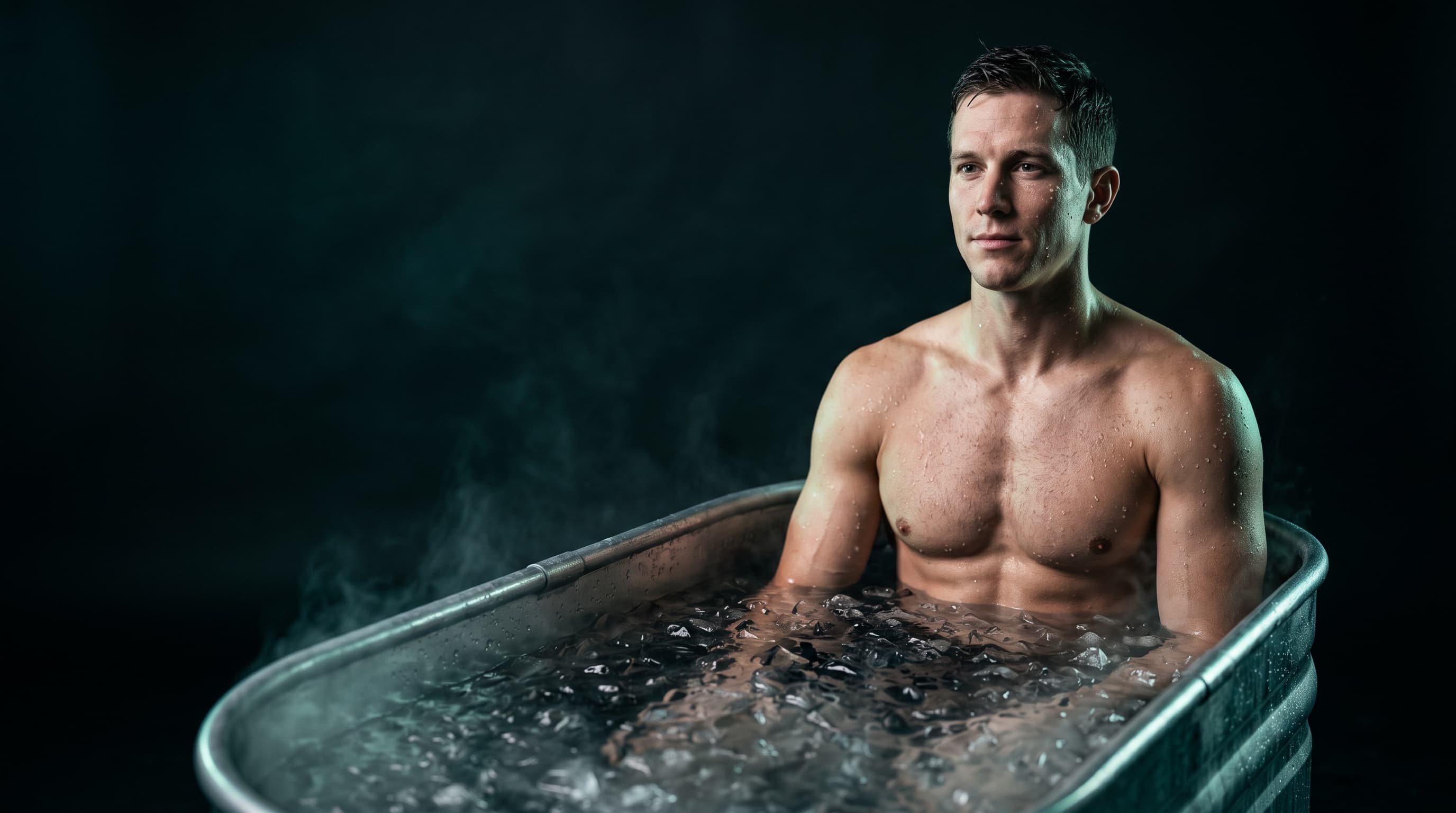
TL;DR: If you want muscle, do not get in cold water right after you lift. Post-exercise cold water immersion attenuates hypertrophy across the training studies that have tested it, and the mechanism is not a mystery: cold suppresses the anabolic signalling that a hard set is supposed to trigger. Maximal strength survives it better than fibre size does. Cold plunging still does real things for soreness, mood and perceived readiness, so keep it. Just separate it from your lifting by several hours, or move it to a rest day.
The cold plunge is the most oversold recovery tool in the gym right now, and the criticism it gets is usually aimed at the wrong target. The interesting question is not whether cold exposure "works." It is what it costs you when you do it in the wrong window.
For a lifter, the answer is specific: cold water immersion in the hour after training reduces how much muscle that session builds.
What the cold is actually interrupting
A hard set leaves a mess behind on purpose. Mechanical tension damages the fibre, the inflammatory response that follows is part of the repair signal, satellite cells get recruited, and mTORC1 signalling ramps up protein synthesis for roughly 24 to 48 hours afterward. That inflammation is not the enemy of the adaptation. It is a step in it.
Cold water immersion works by damping exactly that. Vasoconstriction cuts blood flow to the working muscle, tissue temperature drops, and the acute inflammatory and anabolic response gets quieter.
Roberts and colleagues (2015) showed this directly in the Journal of Physiology. Lifters who used cold water immersion after strength training had blunted rpS6 phosphorylation, a downstream marker of mTORC1 activity, at both 1 hour and 48 hours post-session, along with higher FOXO1 protein content, a marker on the breakdown side of the ledger. Over the full training block, cold water immersion attenuated muscle fibre hypertrophy. Their own conclusion was that it should be avoided if hypertrophy is the goal.
Fyfe et al. (2019) replicated the pattern in the Journal of Applied Physiology with 16 men doing whole-body resistance training three days a week for seven weeks, comparing 15 minutes at 10°C against 15 minutes of passive recovery at 23°C. Same result: attenuated anabolic signalling, smaller fibre growth, strength gains largely intact.
The pooled evidence, and what it is worth
Two meta-analyses have now put numbers on it.
Piñero et al. (2024), in the European Journal of Sport Science, pooled eight training studies and found greater hypertrophy with resistance training alone than with resistance training plus cold water immersion, with the difference likely real and at least small in magnitude. Cold water immersion did not erase gains. It shaved them.
Grgic (2023), in the same journal, ran the strength side: ten studies, 170 participants, and a pooled effect of -0.23 (95% CI -0.45 to -0.01) against cold water immersion. The attenuation was clearer when the cold was applied only to the trained limbs (-0.31) and did not reach significance for whole-body immersion.
Be honest about the quality here. Piñero's group rated the evidence fair to poor, the samples are small, and almost all of it is young men. This is a consistent direction of effect, not a settled number. If you see someone quote a precise percentage of muscle lost to a cold plunge, they made it up.
Small and consistently negative is still the wrong side of zero for something you are choosing to do. You wouldn't accept that trade on a supplement.
What cold plunging is genuinely good for
Skipping the plunge entirely is an overcorrection. Cold water immersion does reduce delayed onset muscle soreness and improves how recovered people feel, and for an athlete with a game tomorrow or two sessions in a day, feeling better is the point. Blunting some adaptation is a fair price when the next performance matters more than the next mesocycle.
There is also a placebo caveat worth knowing. Broatch et al. (2014) had participants sit in thermoneutral water they believed contained a recovery-enhancing additive. The sham matched cold water immersion on strength recovery, perceived pain, vigour and readiness. A large share of what people feel from an ice bath is belief plus a norepinephrine spike, not tissue repair.
That doesn't make the feeling worthless. Mood, alertness and a sense of control over your recovery all support consistency, and consistency is the input that actually moves body composition. It just means you shouldn't confuse feeling recovered with being recovered. That distinction is the same one that makes HRV-based readiness more useful than a gut check, and it is why soreness is a poor proxy for muscle growth.
The timing rule
You don't have to choose. You have to separate.
Don't plunge within about six hours of lifting. The anabolic signalling window is when cold does its damage. Get outside it and most of the conflict goes away.
Best case, put cold on a rest day. Rest-day cold exposure gives you the mood and soreness benefit with nothing to interfere with.
Second best, plunge in the morning and lift in the evening. Or the reverse, if your training is early.
Cardio-only days are fair game. The attenuation evidence is about resistance training adaptations. Endurance sessions are a different conversation, and cold has been used deliberately in that context for heat management.
In-season athletes get an exemption. If you are playing a sport twice a week and next weekend's performance beats next quarter's hypertrophy, plunge after the game and stop worrying about it.
If your goal is size and you only have one slot in the day, the cheapest recovery lever isn't cold water anyway. It is sleep, and the effect size there is not small. Sleep drives both fat loss and muscle gain far more than any tub will.
How to tell if it is costing you
The effect is small enough that you will never feel it. You will only see it in the trend.
Track the two things that actually respond: your working weights at a fixed rep target, and your measurements. If lifts stall for a month while intake, sleep and volume all held steady, the recovery habit you stacked on top of your best sessions belongs on the list of suspects. Move it, hold everything else, and give it eight weeks.
That's the whole test. One variable, long enough to read, measured against a trajectory you set in advance rather than a memory of how you looked in March. The physique forecast tool will draw that expected line for you so you have something to compare against.
Protokl exists for the same reason. It holds the trend for you, so when a habit like this quietly taxes your progress, you see it in the curve instead of arguing about it on the internet.
Post to Instagram / TikTok
Tap Share, choose Instagram or TikTok, and this 1080×1080 card loads straight into the post composer — ready to publish. Add your caption and point your bio link back here, since links aren’t tappable inside IG/TikTok posts.
Related reading
- How to Train Around an Injury Without Losing MuscleAn injury takes one movement away from you, not your whole physique. Here's what the disuse research says about how fast muscle actually goes, and the four levers that keep almost all of it while you heal.
- PHUL vs PHAT: Which One Should You Actually Run?PHUL and PHAT both promise strength and size in the same week. One of them fits into a real life. Here's how the two programs differ, what the volume research says about the gap between them, and how to pick.
- GZCLP Review: The Best Beginner Program Nobody RecommendsGZCLP fixes the two things that break StrongLifts 5x5: not enough volume and no way to fail gracefully. Here's how the three-tier structure works, where it still falls short, and who should run it.
Want this as a daily protocol?
Protokl builds personalized workout and nutrition plans around your body composition, goals, and experience level. Science-backed. AI-powered. Syncs with Apple Health.
Get Protokl →