Does Blood Flow Restriction Training Actually Build Muscle?
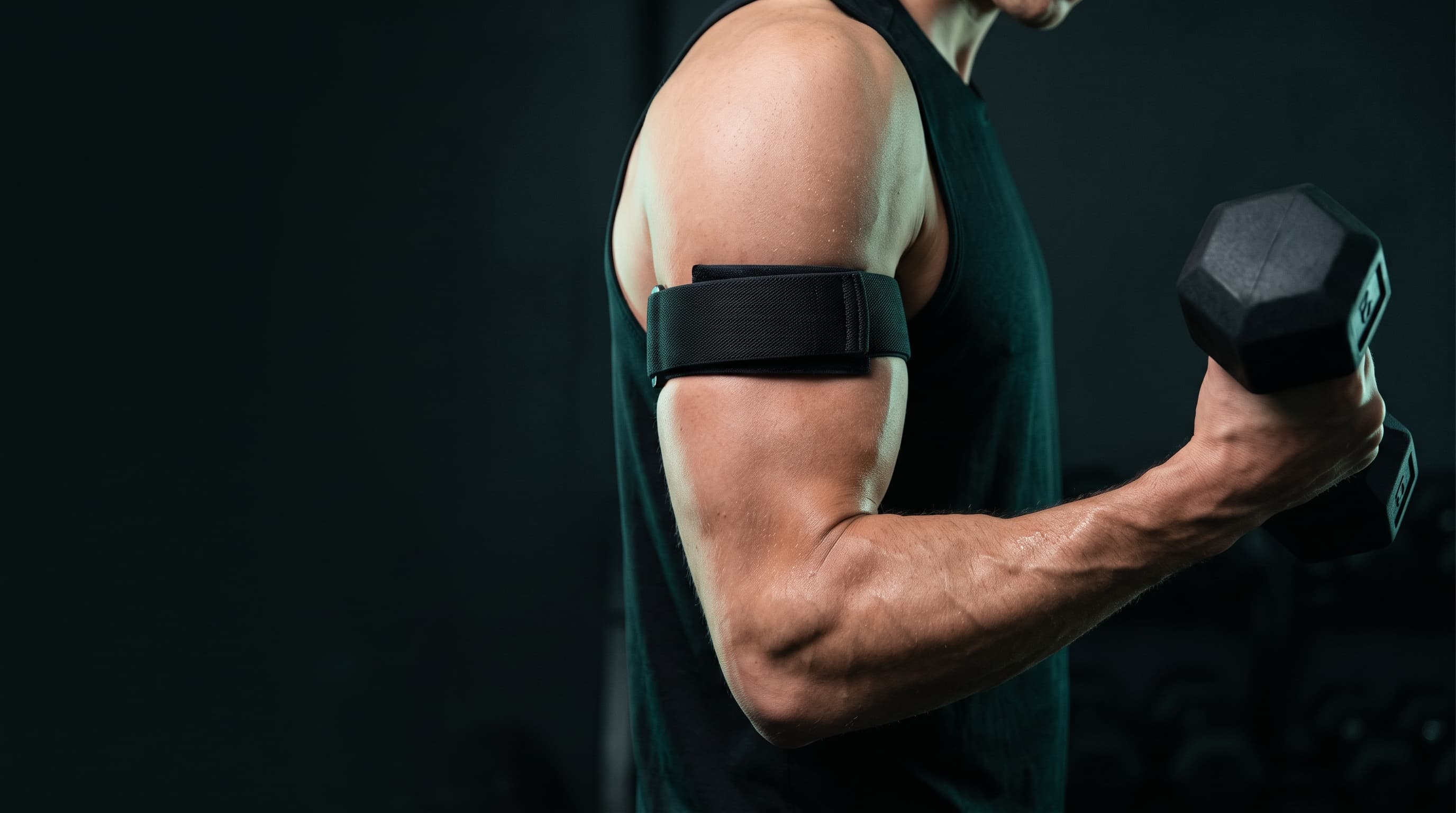
TL;DR: The hypertrophy claim holds up. Across the meta-analyses, low-load training with a cuff grows about as much muscle as heavy resistance training, at loads most people would call a warmup. The strength claim does not hold up as well, and the gap is consistent enough that you should plan around it. Use blood flow restriction to keep accumulating growth stimulus on a joint that cannot handle heavy load right now, or in a session where you have 20 minutes and a pair of light dumbbells. Don't use it as your only source of tension.
Blood flow restriction training, sometimes called occlusion training or by its original Japanese name KAATSU, means wrapping a wide cuff around the top of a limb, inflating it enough to slow venous return without cutting off arterial flow, then doing high-rep sets with very light weight. The arm burns like nothing you've felt from a 25 pound dumbbell. Fifteen reps feels like a set of five at 85 percent.
The obvious question is whether the burn means anything. For size, mostly yes.
What the research actually shows for size
The cleanest way to read this literature is to ask what the cuff is being compared against.
Against light training with no cuff, restriction wins clearly. That comparison isn't very interesting, because light training without a cuff is a poor growth stimulus to begin with.
Against heavy resistance training at 70 percent of 1RM or above, the comparison is close to a draw. Lixandrao and colleagues (2018, Sports Medicine) pooled the trials and found muscle size gains that were statistically indistinguishable between low-load restricted training and conventional heavy training. A 2024 meta-analysis in Sports Medicine Open, looking specifically at moderators of the effect, reached the same conclusion on hypertrophy and found that trained lifters, not just beginners, responded well. A 2024 upper-body meta-analysis in Frontiers in Physiology found the same pattern in the arms.
That's a genuinely surprising result, and it has been replicated enough times that the burden of proof has flipped. If you claim light cuffed training can't grow muscle, you're the one arguing against the data.
The mechanism isn't mysterious. Restricting venous return creates a low-oxygen, high-metabolite environment inside the working muscle. Fatigue arrives early, so the nervous system recruits high-threshold motor units on rep 8 of a set that would normally leave them alone until rep 40. You get the recruitment profile of heavy lifting without the mechanical load on the joint. Similar tension on the muscle fiber, far less on the connective tissue.
Strength is where the gap opens
This is the part that gets glossed over in the marketing.
Lixandrao's meta-analysis found strength gains that favored heavy training, and the finding has held up in later pooled analyses, particularly in untrained lifters. A 2023 systematic review comparing cuff pressure protocols reported the same direction of effect.
That should be intuitive. Strength is partly a skill. Producing a maximal effort against a heavy bar is practice for producing a maximal effort against a heavy bar, and 30 reps at 25 percent of your max is not that practice. Muscle tissue is a large input into strength, but it isn't the only one, and the cuff only addresses the tissue.
Practical version: if your goal is a bigger squat, blood flow restriction is a supplement. If your goal is bigger quads while a knee heals, it's close to a replacement. Work out your actual training percentages before you start, and be honest about where those percentages come from, because 1RM calculators carry more error than most lifters assume. If you need a starting number, the one-rep max calculator will get you close enough to set a 25 percent load.
The dosing the studies actually used
Most protocols in the literature converge on the same recipe. Patterson and colleagues (2019, Frontiers in Physiology) laid out the standard methodology in what is now the most-cited applied reference on this.
Load: 20 to 40 percent of 1RM. Most trials sit at 20 to 30 percent.
Pressure: 40 to 80 percent of arterial occlusion pressure, measured with the same cuff you train with. The lighter the load, the higher in that range you need to go. Training at 20 percent of 1RM means planning on the top end.
Reps: four sets of 30, 15, 15, 15, with 30 to 60 seconds of rest, cuff staying inflated between sets.
Cuff width: wider cuffs occlude at lower pressures. A 5cm elastic wrap and a 12cm pneumatic cuff are not interchangeable, and pressure numbers from a study don't transfer between them.
Frequency: two to three sessions per week per limb is the common range. Some rehab protocols run daily for short blocks.
Two details matter more than people expect. First, proximity to failure. At light loads, stopping three reps short is a much bigger relative cut in stimulus than it is at heavy loads, and that shows up in the data. If you're going to do this, take the sets close to failure. Second, the cuff doesn't exempt you from volume accounting. A cuffed set still counts toward your weekly sets for that muscle, and stacking four sets of arm work three times a week on top of a full program is how elbows start complaining.
Safety, honestly
The most commonly cited safety data is a national survey of KAATSU practitioners in Japan (Nakajima et al., 2006), covering roughly 13,000 people. Subcutaneous bruising showed up in about 13 percent of users, temporary numbness in about 1 percent, and serious events like clots were rare, on the order of a tenth of a percent.
That's a reassuring dataset from supervised practice with proper equipment. It's less reassuring as a guide to what happens when someone cranks a resistance band around their thigh until their foot goes white. The failure mode of doing this badly is arterial occlusion, and the fix is cheap: use a wide cuff, use a pressure you can measure, and stop if the limb goes cold or numb rather than merely burning.
If you have a clotting disorder, uncontrolled hypertension, or you're recovering from a vascular event, this is a conversation for a physician rather than an article.
Where it earns its place
Three situations, and not many more.
A joint that won't tolerate load. Elbow tendinopathy, a cranky knee, a shoulder in the back half of rehab. You keep the muscle while the tissue calms down instead of losing eight weeks of work.
Travel and minimal equipment. A hotel gym with 30 pound dumbbells and a cuff in your bag is a real leg session.
A lagging small muscle group at the end of a session. Arms and calves respond well, cost almost no systemic recovery, and fit in the ten minutes you'd otherwise spend on your phone.
What it shouldn't be is your entire program. The heavy work still drives the strength side of the equation, and strength is what lets you keep adding load over months and years. Cuffs let you keep accumulating growth when the heavy work isn't available. They don't make it optional.
Making the accounting work
The practical failure with blood flow restriction isn't the technique. It's bookkeeping. Cuffed sets feel harder than they look on paper, so people either forget to count them and quietly overshoot their weekly volume, or they count them like heavy sets and quietly undershoot their heavy work.
Protokl tracks volume per muscle group across every session and adjusts your program from what you actually did, not what the template said, so a block of light cuffed arm work lands in the same ledger as your pressing. If you're adding a tool that changes the load but not the stimulus, that's the distinction worth getting right. See how the program adapts.
Post to Instagram / TikTok
Tap Share, choose Instagram or TikTok, and this 1080×1080 card loads straight into the post composer — ready to publish. Add your caption and point your bio link back here, since links aren’t tappable inside IG/TikTok posts.
Related reading
- PHUL vs PHAT: Which One Should You Actually Run?PHUL and PHAT both promise strength and size in the same week. One of them fits into a real life. Here's how the two programs differ, what the volume research says about the gap between them, and how to pick.
- GZCLP Review: The Best Beginner Program Nobody RecommendsGZCLP fixes the two things that break StrongLifts 5x5: not enough volume and no way to fail gracefully. Here's how the three-tier structure works, where it still falls short, and who should run it.
- How Accurate Are 1RM Calculators? (And How to Use Them Anyway)Rep-max formulas can miss your true one-rep max by 10 percent or more, and the error is bigger for some lifts than others. Here's what the research actually shows, and why a slightly wrong number is still the best progress metric you have.
Want this as a daily protocol?
Protokl builds personalized workout and nutrition plans around your body composition, goals, and experience level. Science-backed. AI-powered. Syncs with Apple Health.
Get Protokl →